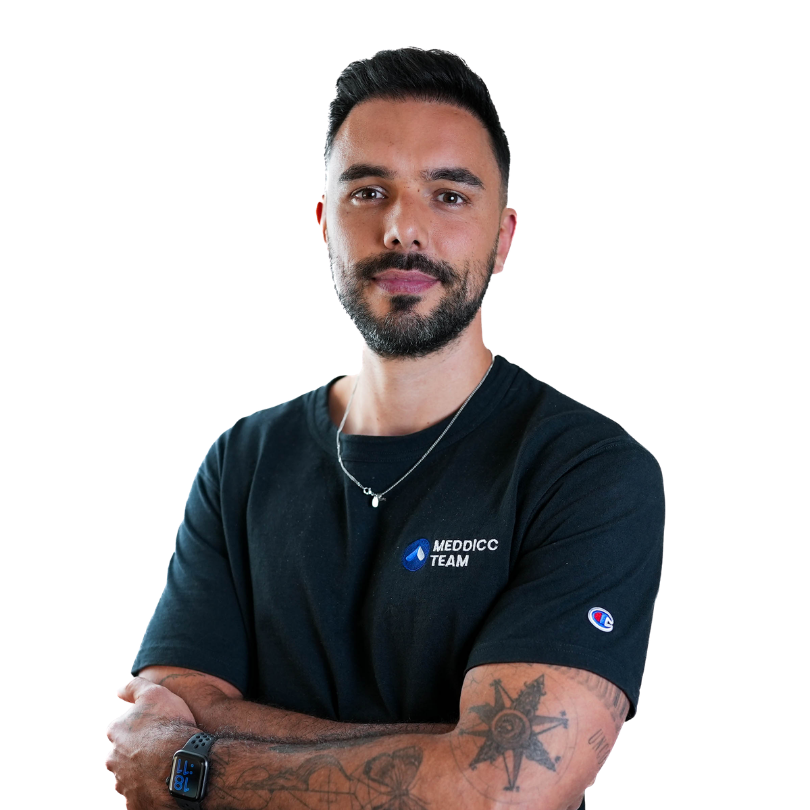
00:00:11 Pim Roelofsen: Hey everyone, this is Pim. Welcome to another episode of the show. For this episode we have a very special guest — someone from our friends at CrowdStrike. Welcome to the show. 00:00:20 Nicole Senna: Hello, everyone. Thank you so much for having me. I'm super excited to be here. 00:00:24 Pim Roelofsen: Yeah. Okay, so Nicole — before we dive into that deal, you have a background within other businesses as well. I think before CrowdStrike it was SecurityAI — good friends of ours here at MEDDICC as well. Was that the first company where you came across MEDDICC? 00:00:36 Nicole Senna: Yes. Ironically, I had started my career at Palo Alto Networks, was there for about two months, and then ended up going to a startup called SecurityAI. I was really focused heavily on the data privacy, security and governance space. There at SecurityAI I was introduced to MEDDICC — I'd met Andy, and he taught our whole sales team the methodology and the framework behind it. Being at the infancy of my career — I believe I was about 22 or 23 — being able to learn that so early really helped me out. And to this day it's had an immense impact on the way I do my work. 00:01:25 Pim Roelofsen: I love that. And the transition from BDR into the AE role you have now is interesting. We didn't talk about this in any of our prep calls, but can you give us a flavor of how MEDDICC helped you transition into your current role? 00:01:46 Nicole Senna: Absolutely. Being a BDR at SecurityAI and learning MEDDICC, then coming to CrowdStrike as an account executive — you're still doing all the prospecting and strategic outreach. For me the most important thing is having that hierarchical approach to outreach. You don't want to reach out to someone who maybe doesn't have the influence you need. You want to go for directors, VPs, heads of IT, even CIOs — because in today's environment, CFOs also have a lot of say as the economic buyer signing off on a cybersecurity project, especially given how central that is to a company's infrastructure. Learning MEDDICC at the infancy of my BDR career further helped me as an AE to build out that hierarchical outreach and reach prospects I know will have the capability to be my champion — and to build that champion and gain trust throughout the whole deal cycle. 00:02:47 Pim Roelofsen: Yeah, that makes a lot of sense. I immediately start thinking about this as covering metrics, stakeholders and process really well in the BDR context — and then taking that into your next role as an AE. And in your introduction you said it already: you were specifically in the SMB space. And I think there's a question that comes up sometimes — we see it with prospects we work with: how does MEDDICC relate to SMB sales? Sales cycles are typically shorter and it can seem less complex than selling to a true enterprise, where MEDDICC was really created. The question is usually: is MEDDICC relevant for SMB sales too? And we always say yes, absolutely — because you're still doing professional customer engagement and professional selling, and that's what MEDDICC underpins. It gives you something to focus on: the right things, the right deals, value messaging, proactively influencing decision criteria. So I'm really excited to have you here specifically from that SMB perspective. 00:04:03 Nicole Senna: Yeah, I was going to say — MEDDICC is equal across all functions and sectors within a business. But I would say it's almost most important within SMB, just because you don't have a large number of people to work with. So ensuring you're gaining the trust of your champion, having that relationship, making sure you're in lockstep — having syncs with your champion, never losing contact with them. And multi-threading, something you've covered in previous episodes: being able to get all the right resources in place early in the opportunity is really crucial. At the time I was pretty green in my sales career, so having my manager with me and learning from him firsthand further enabled me to take it into future opportunities. It was a really eye-opening experience. 00:04:53 Pim Roelofsen: Are we giving a shout-out to Cosmo here? 00:04:56 Nicole Senna: Yes! Cosmo — best leader ever. 00:05:00 Pim Roelofsen: Love it. So — if you take it back to the beginning of this deal, how did it come about? What was the pain that you identified that got this evaluation going? 00:05:12 Nicole Senna: It originally came in as a deal registration. My champion at the company we're talking about was actually already a previous CrowdStrike customer. He had purchased Falcon Complete — our 24/7 managed detection and response service offering. The interesting thing about this opportunity was that my champion had come into this hospitality group because their current CIO had absolutely no idea what was going on with the IT infrastructure. So he came in with a strategic roadmap to figure out: what do we need to do to save money, consolidate the platform, and build a better, more robust security posture overall? We identified three really big pain points. One: high cost. My champion was very focused on saving the organization money as a long-term ROI. Two: the incumbent competitor — the current solution in place — was well known for multiple acquisitions and multiple point products stitched together, lacking the visibility and efficacy of a holistic solution. And three: they were essentially locked out of their MSP, but still had to perform platform maintenance themselves. So they weren't getting full visibility. How do you really get the job done when you don't have full access to what you're currently using? So the three pain points were cost, consolidation, and being able to get full visibility and access — being fully protected while still having access to a console. 00:07:20 Pim Roelofsen: You mentioned an incumbent solution. Was the compelling event driving all this an expiring contract — what was the thing that made them take action right then and there? 00:07:32 Nicole Senna: So February 1st was the first day we actually spoke with our champion and the organization, and it became a seven-month deal cycle. The reason we engaged so early in the process was because we knew he was coming in, and he had plans to double the company's growth within three years. Being able to continuously scale out was definitely a compelling event. But we also needed to ensure we had enough time to really prove out the value of CrowdStrike and demonstrate that we were hitting all of their decision criteria for what they were looking for in a holistic security solution. 00:08:14 Pim Roelofsen: Nicole, you've mentioned your main champion a couple of times. Was this the typical role or persona you'd see in your deals? 00:08:24 Nicole Senna: Yes. He came in as the head of IT, and then he ended up getting promoted to CIO — because when he arrived at the company the previous CIO wasn't across the infrastructure, so it made sense that he eventually got the title. In terms of other deals in SMB, I would say the most important people to have conversations with are directors of IT and sometimes senior IT managers. VPs and C-level executives — while they have a good understanding of the overall cybersecurity infrastructure — it's really the directors and managers in IT and information security who see the day-to-day firsthand and know exactly what they truly need. That's why it's so important to get C-level executives engaged as well, because my champion directly reported to the CEO and CFO — the CFO being the economic buyer. So we knew that as long as we came in within the pricing range they were targeting, he had the relationship to get it done. Just having that knowledge — that our champion had access to the economic buyer — was great. As long as we came in with the right numbers and could demonstrate consolidation savings and improvements like adding identity management, which they didn't have before, we were in a strong position. 00:10:18 Pim Roelofsen: Absolutely, you're spot on. And if we look at champions — we tend to think in the plural, to make sure we don't rely on just one person, because people leave, change roles, whatever. Build in redundancy. And we always say a champion doesn't start as a champion — they start as a contact. You assess whether they have the traits of a champion and then you build them up. In this case, having someone who was already a previous customer — if you've had a successful relationship in the past, that's probably as good a starting point as you can have. But it's still not a foregone conclusion that that person will act as your champion again, sell on your behalf when you're not there, coach you on how to win, or get you that introduction to the CFO. Can you talk us through that journey with your champion — when did you know they were a qualified champion? 00:11:22 Nicole Senna: I didn't want to be the one to promise outcomes and then not deliver. So early on it was really important for me to hear directly from him exactly what they were looking for. Early in the process he was very focused on pricing — he didn't share any numbers, just kept telling us to get as low as we could. That was genuinely one of the biggest challenges, because you want something to work with. In cybersecurity, you can only go so low. But throughout the opportunity, being in lockstep with him — having those weekly check-ins, whatever they were, 15 minutes or five minutes, walking through the whole process, whether it was procurement or legal — I would say I knew he was my champion honestly from the very first call. He was so committed to bringing CrowdStrike on board, but wanted to make sure his team was involved so they could see the potential value and the additional support we'd bring. Establishing him as a champion was early — it was then just a matter of coming in with the right pricing and being able to convey our message: we're here for your consolidation approach, we're giving you more at even a lesser cost. And as you continuously scale and double the company's growth, we want to earn that business and grow with you. He really appreciated that. And I feel so grateful for the relationship we built from start to finish. At the end, he was very happy and willing to do a CrowdStrike Protector Spotlight case study for us. When you're in sales, if a champion from one of your won opportunities becomes a reference for you — I think that's the biggest win you can have as a sales rep. 00:13:46 Pim Roelofsen: Spot on. And the Protector Spotlight is essentially a case study and reference piece — just to clarify for anyone listening. So, prior to talking about your champion validation and qualification journey, you touched on decision criteria. We've talked about the initial pain you identified, the compelling event tied to it, having a champion so you're not selling in the dark, and slowly getting the insight you need as part of your mutual evaluation. Decision criteria is where you make it specific — the how and the why of mobilizing the value for CrowdStrike. Can you talk us through how you and the team went about influencing, solidifying and locking in decision criteria with this hospitality group? 00:14:41 Nicole Senna: Absolutely. In terms of decision criteria: one was support and the consolidation approach. With CrowdStrike's managed detection and response offering, you have the CrowdStrike solution backed by CrowdStrike personnel directly — there aren't multiple tiers or levels of support to navigate. So in terms of the metrics tied to those decision criteria: being able to consolidate, but also add additional modules — specifically the identity and cloud security pieces — we were able to save them over 20 hours a month in platform maintenance. Now they have a fully managed platform plus fully managed identity and cloud security on a single UI. Instead of managing three different consoles and two different support teams — their MSSP and the incumbent competitor — they now have one. Associating decision criteria with measurable metrics was really important to me throughout this. 00:15:57 Pim Roelofsen: Absolutely, you're spot on. And the way we want to think about metrics — and I know we agree on this as partners — is that the story of quantified value successfully delivered for a customer previously has to be tied to a decision criterion. Otherwise you leave the door open for a rival to come in and say, yeah, I can do that too, and maybe cheaper or faster. Those two things are always going to be interlinked. And I liked that you immediately also got behind the technical decision criteria, because that's table stakes. The power of any really strong product is that it delivers economic impact as well — which is more than just pricing. So I'd love to get into the later phases of this sales cycle. You should be getting ahead of the paper process. But in our prep you mentioned something interesting about what happened during the final stages. Can you talk us through that? 00:17:32 Nicole Senna: Absolutely, Pim. One of the most interesting things that happened toward the end of the opportunity was that once we were getting into the procurement, legal and paper process, we had sent over our MSA — our terms and conditions — and we'd been redlining it back and forth for probably two or three months. Then right when we were at the finish line — literally the last day the opportunity could close to avoid a gap before their renewal — we got a call from our champion. He told us there were some internal politics happening. He had discovered that one of his own IT team members was putting a halt on the process within the legal team, telling them not to sign the NDA, so that it would come close enough to their renewal date that they could just keep the incumbent. That person had been at the company for over five years. My champion had come in brand new, essentially wanting to rip and replace everything — and that didn't sit well with him. Understandably, he would have preferred to keep the incumbent and the MSSP relationship he'd already established. So that day, we got that call from our champion. He said: I'm going to get the NDA signed today. Send me that quote. And within hours, what we'd been waiting on for about three weeks was done — just like that, off one phone call. That was a real eye-opener for me. You have to be aware of internal competition and make sure it doesn't derail an opportunity this significant. And having the relationship with your champion to just be able to call and say — hey, it feels like this has been sitting for a while, is there anything we can do together to speed this up? I know your renewal is in 15 days, you wanted at least two weeks to deploy to new endpoints — that conversation matters. It worked out, and I'm incredibly grateful. Internal politics are very real, but working around them professionally is so important. 00:20:28 Pim Roelofsen: You're spot on, because there are quite a few lessons in this. And obviously it came out the right way. But there's an opportunity to learn from it regardless. What you're telling us is that you had competition — whether that's inertia and staying with the status quo, or reinvesting with a rival. And that category of competition had a champion as well. The question becomes: who has the more powerful champion? That's how you want to think about stakeholders. It seems your champion definitely won that battle. But it's not a foregone conclusion — especially when someone is new to a business and another person has been there for years and is deeply attached to the current solution. They don't want to see it replaced, because that reflects on their past decision too. So that's super interesting. You should be proud of how it played out — but at the same time, keep it as a lens to stay sharp on going forward. 00:21:56 Nicole Senna: Absolutely. And the biggest thing about this opportunity is I had only been at CrowdStrike for four months. So this was incredibly eye-opening. I had learned so much — partly because, as I said, I was at the infancy of my sales career. One thing that was really important for me to develop was equal business stature and confidence. Just because someone has been in the industry for 20 or 30 years and I'd only been doing it for four months — it was intimidating, absolutely. But having the confidence in myself, getting my manager involved on every call, and learning from the way he could articulate everything so clearly — it was awesome. I learned a lot and I'm incredibly grateful. That one opportunity — in terms of applying MEDDICC, being able to use it then and carry it forward — it's like peeling back the onion. Something I know I can continuously keep learning from. 00:23:05 Pim Roelofsen: That's spot on. If you go back to the beginning of our conversation — from BDR to AE, whether you're a year into your career or 20 years in — the learning never stops. The growth mindset you're describing is something everyone should strive for. I know I still learn things every day, and I probably will for the rest of my life. In the context of this conversation — your BDR role at SecurityAI, your current AE role, the ways you've used MEDDICC — what is your single biggest learning from the common language we're talking about when we talk about MEDDICC? 00:23:50 Nicole Senna: The single biggest learning I've applied both in my sales career and with MEDDICC is to have a conversational approach. It's not a script. At the end of the day, you're having a conversation with somebody — peeling back the onion, asking them questions tailored to exactly what they're potentially looking for, and then exploring ways you can help. In SMB, M1 and M2 metrics are crucial to proving value. Here's how we've helped an organization in a similar, relevant industry — is this something you're also dealing with today? If so, here's how we could potentially help. And then taking those M1 metrics and applying them to their M2 context — their specific situation. You're creating a path of success by curating all that context, so that in the future, when another organization has a similar security stack or similar challenges, you can relate back to it. Rather than just throwing up a PowerPoint or talking all about CrowdStrike — because CrowdStrike is great, I'm glad you're here, but really: what are you here for, and how can I help you? Tell me everything, and that helps me help you. My goal is to earn your business and really understand how I can relay previous stories and previous champions. And as I said — a reference from a previous champion you've won a deal with is the biggest win you can have as a sales rep. 00:25:57 Pim Roelofsen: Absolutely. You're spot on — and M1s, bridging them to M2s, and then once you're successful, M3s tied to the mutual goals you have once they're live with your solution. They empower you to have a foundation for talking about value connected to the right stakeholders and running your process more successfully. So you're absolutely right. And as we're talking about what we've learned and what we get to keep improving — what is something you personally feel you should focus on to raise the bar further going into the rest of your fiscal year? 00:26:31 Nicole Senna: Personally, two things: metrics and decision criteria. In SMB sometimes organizations don't necessarily know exactly what they're looking for. Sometimes they're just evaluating because things aren't completely broken — they haven't been breached, nothing is visibly wrong. That's where I find it harder, because it's difficult to justify the cost of a solution two or three times the price when the customer doesn't readily see the value if everything looks fine today. So truly asking questions geared toward understanding contextualized decision criteria — and then gaining metrics from what they're sharing — those two things play really well with each other. That's something I definitely want to work on. And procurement. In SMB, getting ahead of the paper process early is crucial. Making sure you know: are there any legal steps we need to have in place, so that when we're ready to sign at the end of the month, we're not suddenly hearing the legal team needs an NDA first? Getting ahead of all of that on the first or second call is so important. So for me — metrics, decision criteria, and paper process. 00:28:08 Pim Roelofsen: Absolutely. I really resonate with that. Something you said there: your customers don't necessarily always know what they're looking for. And I think that gets overlooked, because whether you're a head of IT or a CIO, buying technology is probably not the main part of your role. You're not a professional CrowdStrike buyer — and arguably in your line of business, in SMB, that's even more the case than elsewhere. If you're running a hospitality business, you're probably most focused on the experience your guests will have. So what you want to keep in mind is that you are the professional seller. And what metrics and decision criteria do really well is articulate the value you can deliver and exactly how — so people can get educated. And MEDDICC helps you do that in a contextual, story-driven way, so people can start seeing the vision you're giving them, reach consensus, and start building their own version of that story for it to become a reality. And that's ultimately what your champion does from experience. But if you don't have someone come in as a previous customer, MEDDICC can be extremely effective in helping you achieve that. 00:29:44 Nicole Senna: Absolutely. And you had actually asked about a reference call — and I remember he also wanted a proof of value. But because of the timeline and the way the paper process was moving, right toward the end he was just ready to go. He already knew how we operated from the past and it had been a success — so he wasn't hesitant. We wanted to let his team see it working in live performance, but because of the timing, he didn't end up doing the reference call or the POV. I found that interesting. What makes someone want a reference call and a proof of value, and then ultimately not follow through? I had the reference call set up — he just never called. Sometimes I wonder: why would you go in thinking you need these two things and then fall back? 00:30:51 Pim Roelofsen: If I had to guess in this case — it's prior experience winning out over following the buying procedures of a company he'd recently joined. But it's definitely good to cover all your bases and actively influence decision criteria, which is effectively what you're doing when you set up a reference with another customer you've helped succeed. Time is running away from us. I really enjoyed having you on the show. We'll wrap up now. Thank you so much, Nicole. Let's stay in touch — and let's see if the record you set with this hospitality customer gets broken, hopefully by yourself, so we have something new to talk about. 00:31:42 Nicole Senna: I love it. Thank you so much, Pim. It's honestly such an honor to be here. I absolutely love listening to your podcast and watching Andy on LinkedIn, and just being part of the MEDDICC community — you're all awesome. I really appreciate everything. Thank you so much for having me today. 00:32:05 Pim Roelofsen: Awesome. Love it. Thank you, Nicole. And this was another episode of Elite Dealers — thanks for tuning in, and we'll see you next time.