







































The Economic Buyer is typically one person within an organization who has the final say on whether your product, service, or solution receives any budget. In some cases, the Economic Buyer is not a single individual but a committee, board, or advisory group.
How To Find The Economic Buyer
"Economic Buyer" is sales terminology, and that is an important thing to remember. Nobody from a buyer's organization is going to walk up to you, shake your hand, and say "Hi, I'm the Economic Buyer." It is on you to identify them through a disciplined, process-driven approach that also leaves room for instinct.
Do Not Under-Qualify
The most common mistake sellers make is under-qualifying the Economic Buyer. A weak identification process leads to misidentification, and the search stops too soon.
A seller might find the Budget Holder and assume that person is naturally the Economic Buyer. This is rarely the case. "Budget Holder" is not an official title, just as "Economic Buyer" is not, and customers are never going to proactively explain how their budgeting process works.
Finding the Economic Buyer can be genuinely difficult. Budget processes are confidential, roles are not always clearly defined, and the organizational dynamics involved are not visible from the outside. An important rule: do not focus your qualification on budgetary roles or processes. Budget Holders are not the same as Economic Buyers. A Budget Holder manages and controls access to budgets across departments. The Economic Buyer, by contrast, has the authority to deploy and adjust budgets in service of creating meaningful business outcomes. They will also engage with Metrics at a far higher level than a misqualified candidate.
The opposite mistake is what you might call the CEO error: over-qualifying to the point of assuming the most senior person in the room must be the Economic Buyer. A CEO will have access to budgets and the authority to use them, but is very rarely the Economic Buyer in practice.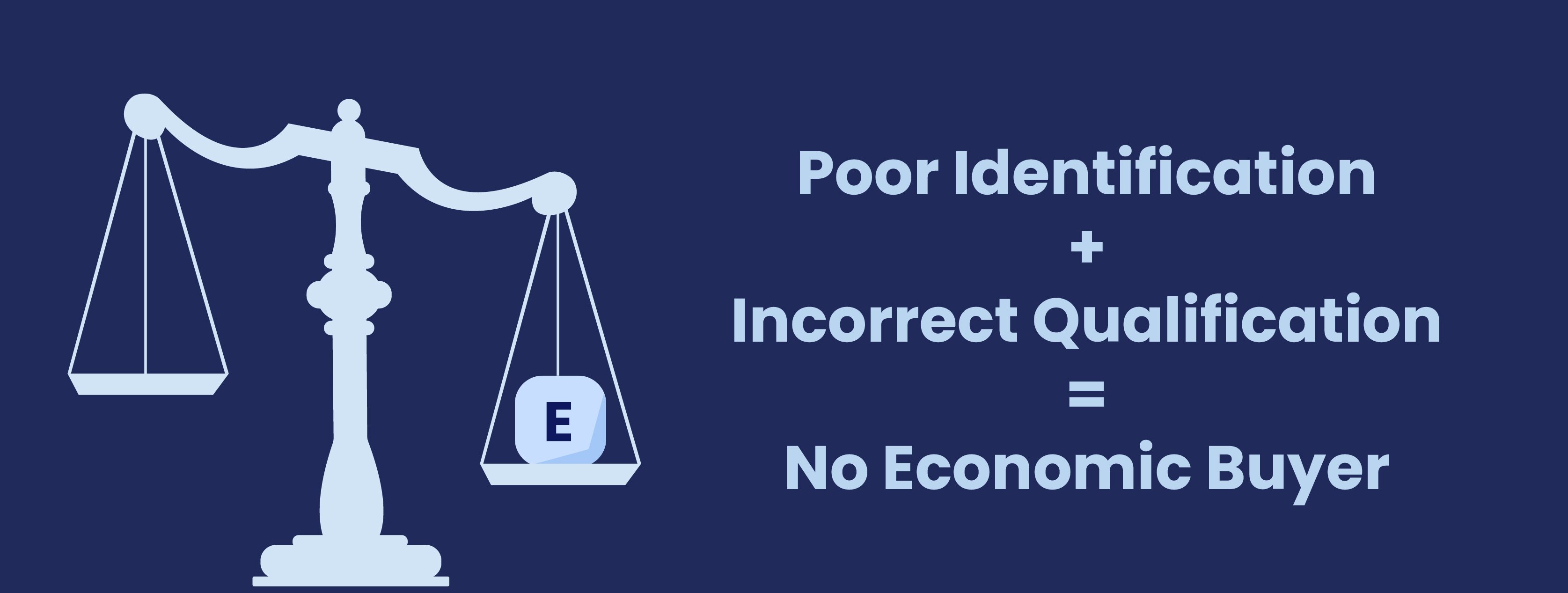
How To Correctly Qualify the Economic Buyer
When qualifying the Economic Buyer, apply the following criteria to individuals in the customer's organization:
-
They have the power and authority to veto project progress and the influence to stop/start it, regardless of your Champion
-
Their primary objective is to fulfill the goals of the organization, and they have a significant role in quarterly and annual planning
-
They can get access to funds that aren’t necessarily attached to budgets
-
They will be the ones taking the brunt of responsibility for profit/loss situations
-
They will be in the contractual process, most likely the ones to authorize sign-off or approvals.
The Decision-Making Process For Economic Buyers
Once you have correctly qualified the Economic Buyer, you need to understand how they make decisions. They will not be interested in the features and functionality of your solution. What they care about is the impact on their business's bottom line.
To make your solution stand out in their decision-making process, connect it clearly to the problems, obstacles, and pain points their organization is facing. At the core, an Economic Buyer evaluates a solution against three questions:
-
How much does it cost?
-
How long till the organization realizes its value?
-
How easy is it to use for the people in the organization who will need it?
Economic Buyers will bring prior experience with sellers into their process with you. They may be more intuitive and discerning as a result, but they may also be more cautious. Look for connections you have at an executive level to help reassure and support the progress of your engagement with them.

After the Deal: Keeping the Economic Buyer Close
Once the deal is won, the Economic Buyer will typically step back from day-to-day involvement with your solution. The best salespeople know this is not the moment to lose contact.
Keeping the Economic Buyer updated on implementation progress, particularly on the outcomes and problems your solution has addressed, pays dividends well beyond the effort it requires. It strengthens the case for future upsells and positions them as a valuable reference point in future deals.
The Economic Buyer holds the ultimate authority on any deal. Engaging with them well throughout the process matters enormously. A practical tip: bring a sales leader into Economic Buyer meetings. It gives the seller and Champion the opportunity to present compellingly, while the sales leader provides support and can make decisions or commitments that the seller alone may not be in a position to make. In a tight deal, that dynamic can make all the difference.