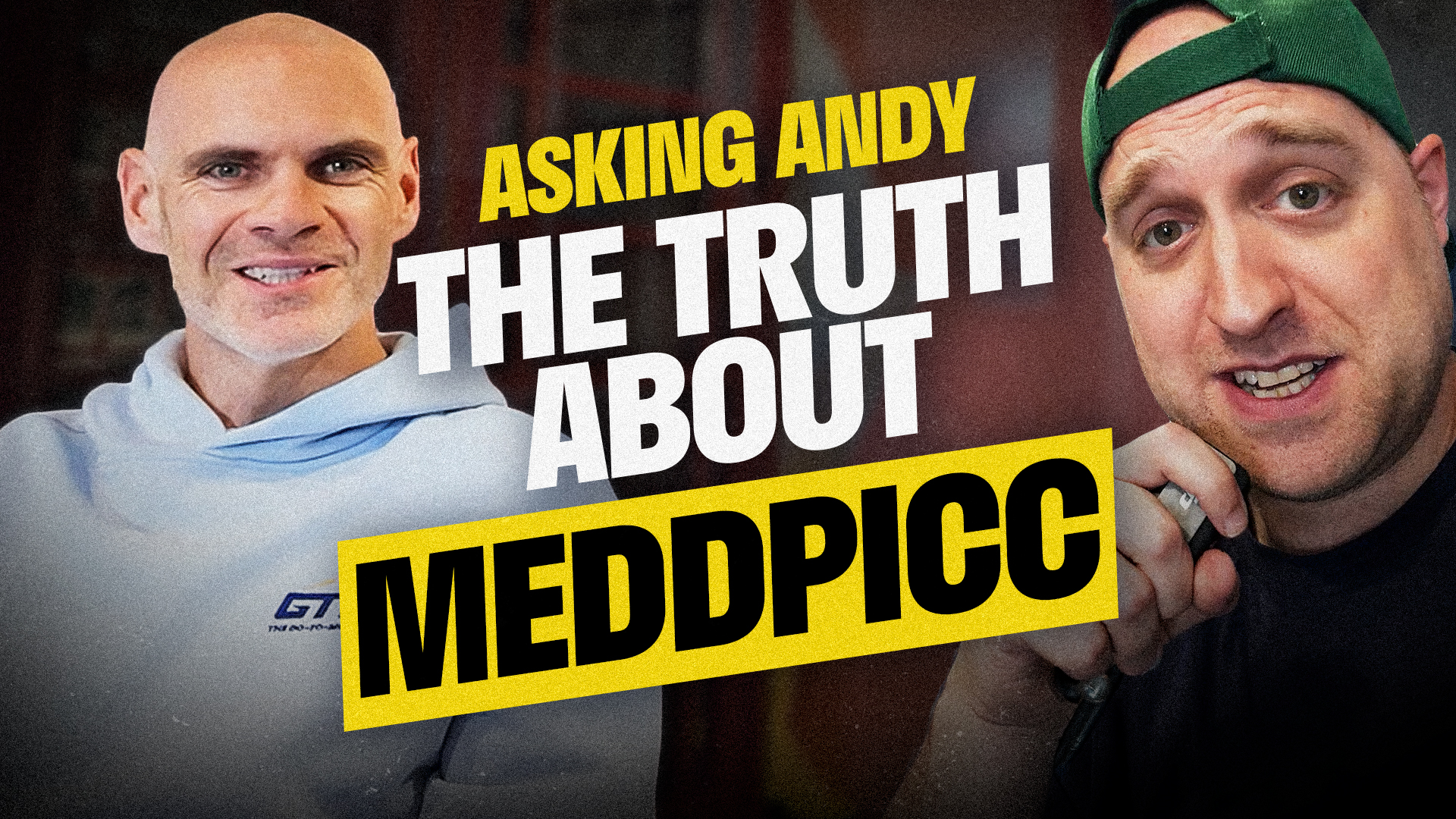
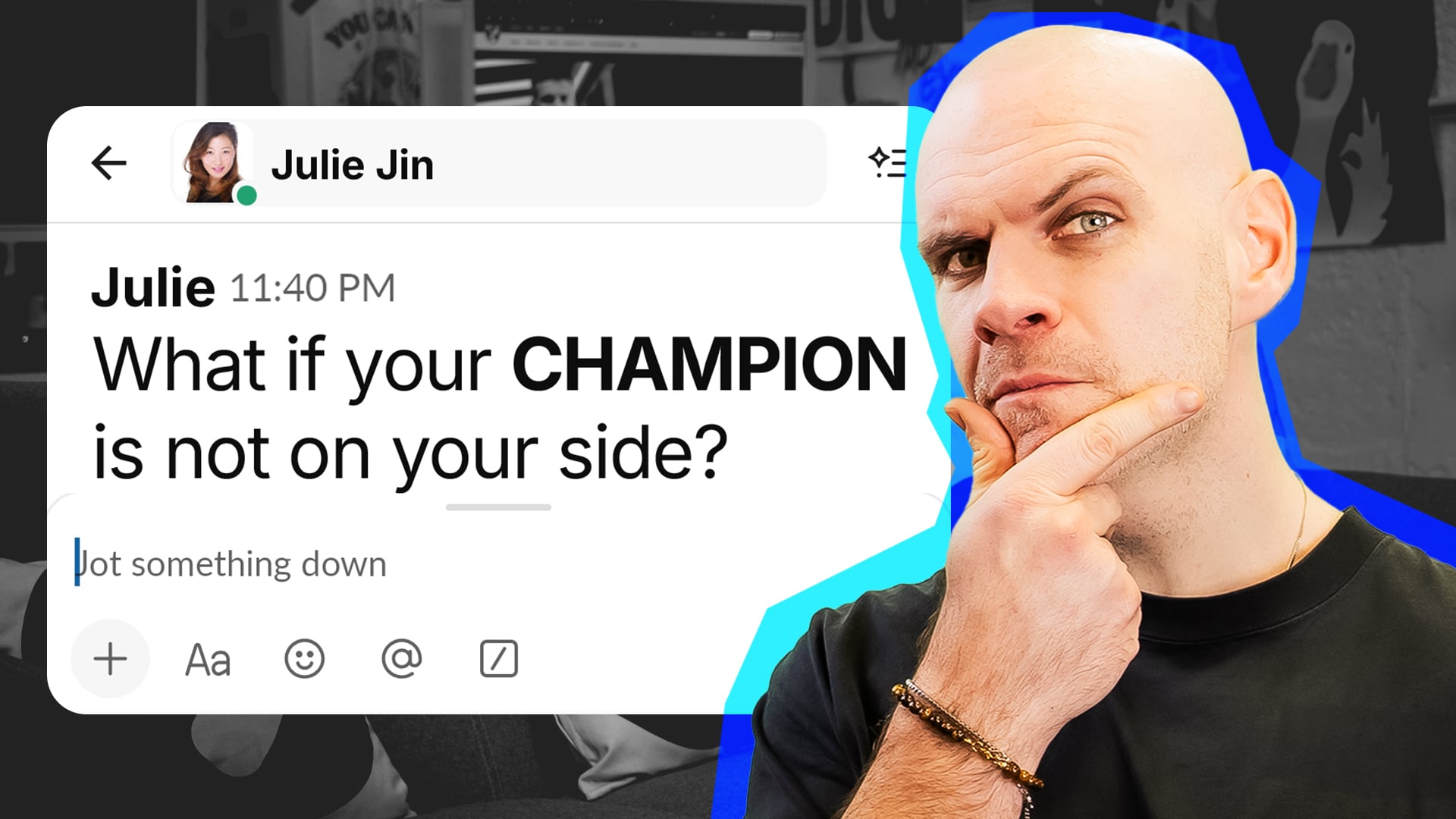
00:07 Pim Roelofsen: Welcome to The MedMen Show. That's Andy — 00:09 Andy Whyte: — and this is Pim. And this is the very first episode and start of Season 2! 00:15 Pim Roelofsen: Season 2. We missed it. We're back. And it kind of feels like a next step — going from Season 1 to Season 2. But we started even before that, right? With the pilot — you were a customer of ours, which is kind of fun. And we did it over Zoom. I think I might have been wearing the same jacket in that pilot episode. We'll have to double check that. But yeah — full circle. Bigger budgets now. A full wardrobe. A wardrobe assistant. Better whiskey. 01:01 Andy Whyte: Better whiskey. Cheers! Here's to Season 2. 01:04 Pim Roelofsen: Season 2! So — what are we talking about today? 01:06 Andy Whyte: We are going to talk about a few different topics, but we're going to start with misidentifying your champion as the economic buyer. Are they one and the same person? It's actually a question we get more commonly than we feel we should. And what we put that down to is not so much that it's happening more — it's not that the champion and economic buyer personas are merging or becoming closer together. It's more that people are misidentifying either the champion or the economic buyer. More commonly what's happening, if I'm honest, is that people are misidentifying the champion as an economic buyer. They probably have a coach they're calling their champion, and they're looking to that coach to introduce them to who they think is going to be the true champion. They get to that person and all of a sudden they've classed them as the economic buyer all along — but then they realize this person is actually more like a champion. And then they get into this conundrum. 02:14 Pim Roelofsen: Yeah. And the tricky bit is that you either end up winning the deal and then realize: hey, actually my proposed EB was my champion all along, and there was a different individual within the organization — like a CFO — who ended up being the economic buyer. And if you win, it feels like it doesn't really matter anymore. But if you lose the opportunity and come to that realization after the fact, it's an opportunity missed — you should have been more proactive about it. So whenever someone says "my champion and the economic buyer are the same person," the first thing I think is: are you sure? And when you start peeling back the layers of that situation, you typically find they're not. 03:06 Andy Whyte: Absolutely. And I want to go back to the point you made about winning the deal and thinking it's OK. People look at winning and losing as the only definition of success and failure. But the standard we should all hold ourselves to is higher than that. If we qualify incorrectly, we shouldn't be losing deals — we should be qualifying out of them. So the definition of success isn't did we win or lose. The definition of success is: did we win for as much value as we could have, as quickly as possible? 03:57 Andy Whyte: And the main factor that's going to drive success — higher deal sizes, faster closes — is economic buyer support. When you're not engaged with the true economic buyer and the deal gets to procurement, to negotiation, to legal — all those things that slow a deal down and start to cut away at the deal size — it's the economic buyer who has the most power to hold the line. If you're truly engaged with the true economic buyer, you're in the best position to defend your value, and you'll have that executive support to accelerate your deal towards closure. So the idea of "turns out we got it wrong — that person wasn't the economic buyer, it was somebody else we didn't get to — but hey, we still won the deal" is probably not as good a situation as you think it was. It probably took you longer to close, and you probably got beaten up by procurement because you didn't have that executive support behind you. 05:07 Andy Whyte: And it extends further into the customer lifecycle too. Because typically your partnership with that customer doesn't end at the first deal. The EB persona — whoever that person is — isn't disappearing. You need them. So if you don't have them already, you're also not set up well to build a fruitful, successful, long-lasting relationship with that customer. 05:46 Pim Roelofsen: Sure. Now — there are some instances where I do believe the champion and EB can be the same person. And I want to make the point: they are not common. It can happen with smaller organizations where you're dealing with the owner of the business, or someone very senior where, just by the size of the company, the person responsible for purchasing is also very senior — so the economic buyer and champion can be the same. It can also happen in strange circumstances. We've had situations where we've been championed by people — I think of one organization with a terrific CEO and founder who championed MEDDIC into their company. But here's the point I want to make: even if we look at that person and say "they're the CEO and founder of a public company worth billions, and nobody in the organization wants MEDDIC more than them" — great. They're certainly a champion. Certainly they've got power and influence. They have a vested interest because they care about the success of the company. They're selling internally, getting their CMO on the call, their CRO on the call. They were championing us. And they're almost certainly also the economic buyer because they're the CEO. 07:14 Andy Whyte: But this is where the challenge comes in when people try to merge the two. You need a champion in your deal because you need that person pulling people together, wrangling with procurement, getting responses back on all those things — a hundred other things. And the CEO of any company, by the nature of the economic buyer persona, is not the person you want to be relying on to do those things for you. So even if you have this unlikely but quite good scenario where the economic buyer is championing you — you want to find somebody else to act as a delegate champion. Someone who can run the field, do all the things you want a champion to do. Otherwise you're going to find yourself in serious challenges from a decision process and paper process perspective, trying to move the needle forward when you're relying on someone who will always have more important things on their plate. 08:10 Pim Roelofsen: Yeah, absolutely. I think it's useful to get into some questions we can ask when we're in an evaluation with a prospect — working with our proposed champion — to make sure we don't end up merging those two personas and having it backfire later. Your classic decision process questions — you can ask your contact, who you're assuming is at least a champion: "The last time you purchased a solution like this — how did that work?" We know that's a great question to uncover foresight rather than just asking about the process itself. But even simple questions — "who's going to sign this?" — can provoke thought. Asking them about the CFO: "Is the CFO interested in this? What's their view?" And the classic: "If this were to be stopped — who would that be? Who's the person that could stop this, and why? What have you seen happen before?" 09:32 Andy Whyte: And you don't have to ask those questions as bluntly as that. You can frame them from the perspective of a true champion with a vested interest, working towards a compelling event you both see on the horizon. You can ask from the context of "in our pursuit of our mutual goal" — what are the things that go wrong? Who's a person it would be better to proactively engage with, just in case? The last thing you want is for someone to feel like they haven't been included. Those questions are going to help you uncover risk in your decision process, but also start to feel around who else could be the economic buyer. And it goes back to getting ahead of things — keeping velocity in your deal, not merging the champion and EB personas, and making sure the paper process is understood and worked on proactively early in the cycle. 10:53 Pim Roelofsen: Absolutely. And the last thing I'll say on this: every organization should be doing deal reviews. No question about it — at least weekly deal reviews with your sales team. Because whatever situation you end up in, if you feel like your champion is also the EB — chances are the people around you, your colleagues, have seen something similar every single day. So there's best practice, there are examples of how this has been overcome before, and you can tap into the power of the team to uncover the right actions to take in that deal. 11:44 Andy Whyte: For sure. So to summarize: first things first — if you're wondering whether your champion is also the economic buyer, typically that's not the case. So you've got some work to do, some thinking to do, some investigation. Look deeper into it. Second: if there is a strange scenario where the true economic buyer is also acting as a champion — it's a good thing, not a bad thing. But you're going to have to find somebody else to do the legwork, to make progress, because economic buyers by definition won't have the bandwidth. You're still going to have to separate them. You can even say to your economic buyer: "Is there someone close to you we can work with on some of the more logistical things?" And then there are the obvious questions — who can stop this? How has this worked for you before? What's the CFO's perspective? Are they aware? 12:56 Pim Roelofsen: Yeah. And the last point I'll make in summary — it's never too late to figure this out. We had a situation near the late stages of closing a deal where you and I realized that who we thought was the economic buyer — the CEO and founder of a large public cloud company — was actually not the economic buyer. It was the CFO. And the reason we found that out was that person started saying: "What I need from you to get this past the CFO is these things." And that was the alarm that went off. We should have identified that earlier, but if we're honest — we got a bit C-level drunk. We were talking to a founder, our champion had made a big introduction, all the signs of that person being the buyer were there. But you should never settle. Always be asking: has this evolved? Has the deal size grown to the point where it's moved out of the current economic buyer's control and into more senior hands? Treat the CFO as the economic buyer by default, unless proven otherwise. 14:57 Andy Whyte: Exactly. And now more than ever you see CFO scrutiny on even lower investments than before. So it's never going to hurt you to approach it that way. That probably sounds like a great topic for a future episode! With that — cheers, and see you next time. And don't forget to like and subscribe on all your favorite platforms to catch every episode going forward.









































.png?width=273&height=327&name=image%201%20(1).png)