



































MEDMEN: Jessica Walker - What Marketing Gets From a Common Language
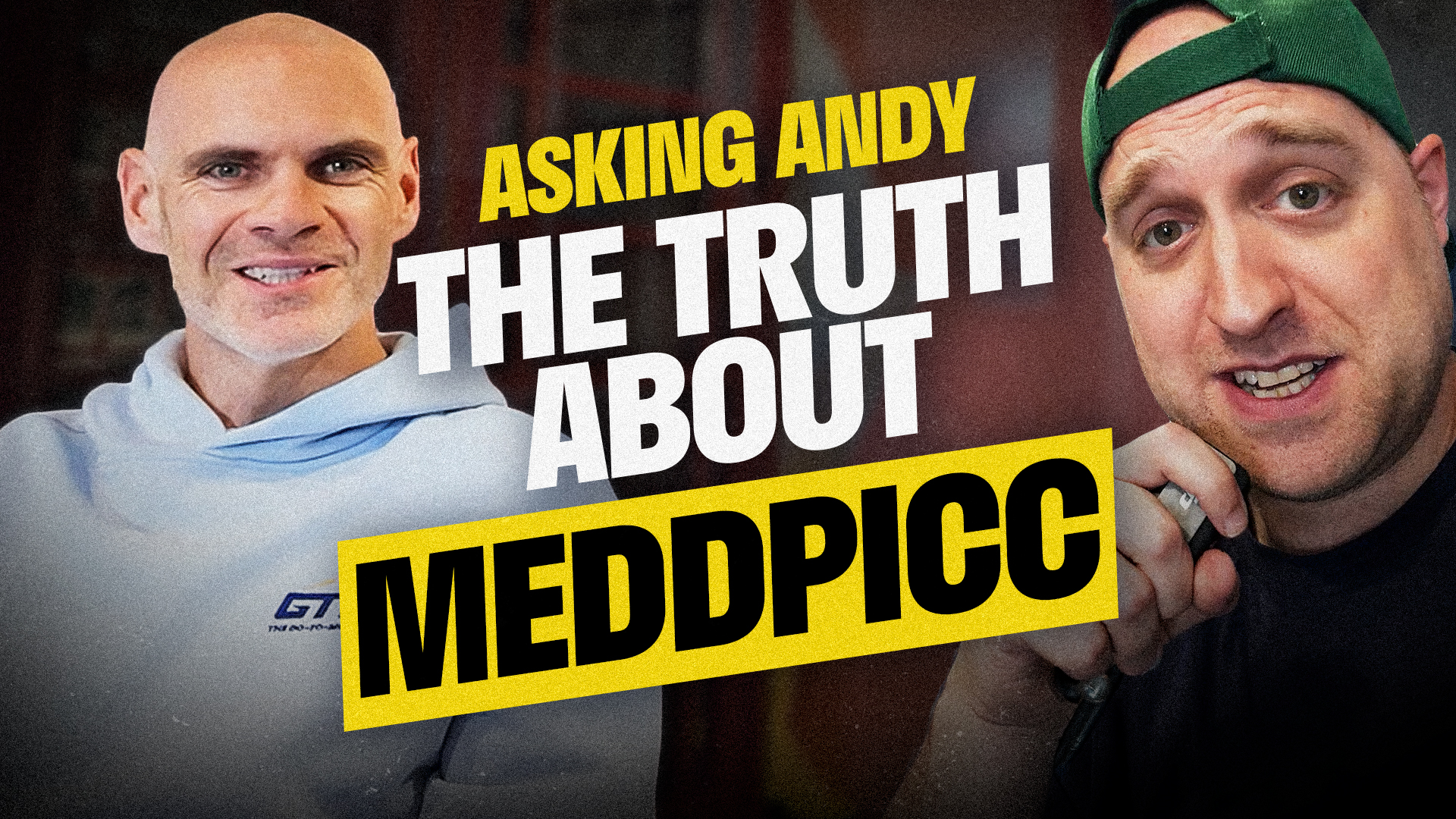
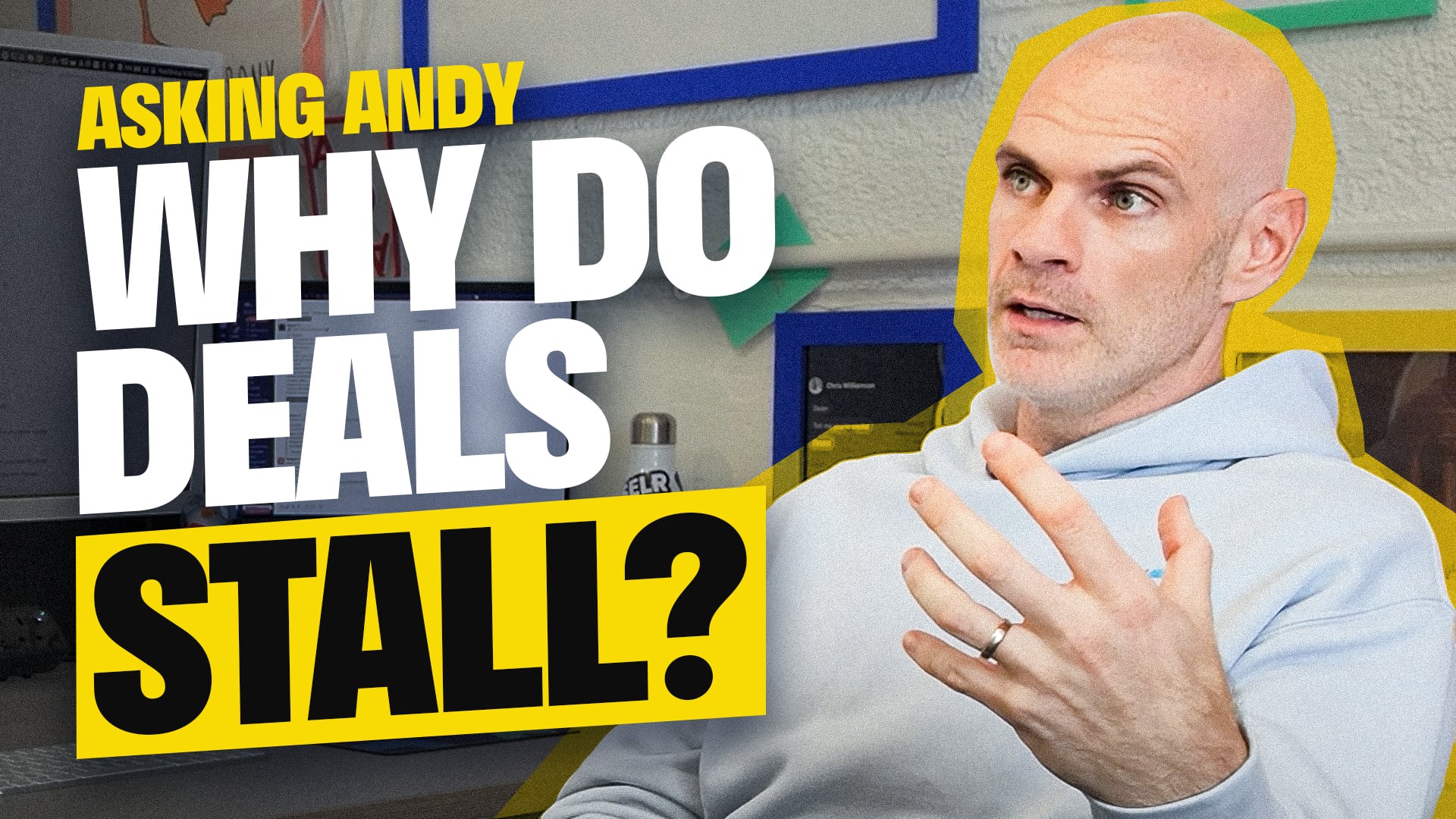
Andy Whyte and Pim Roelofsen host Jessica Walker on how Marketing uses MEDDPICC, especially Metrics, to align with Sales on a shared dataset.
August 29, 2024
54 minutes
NOTES
GUESTS
TRANSCRIPT
KEY TAKEAWAYS
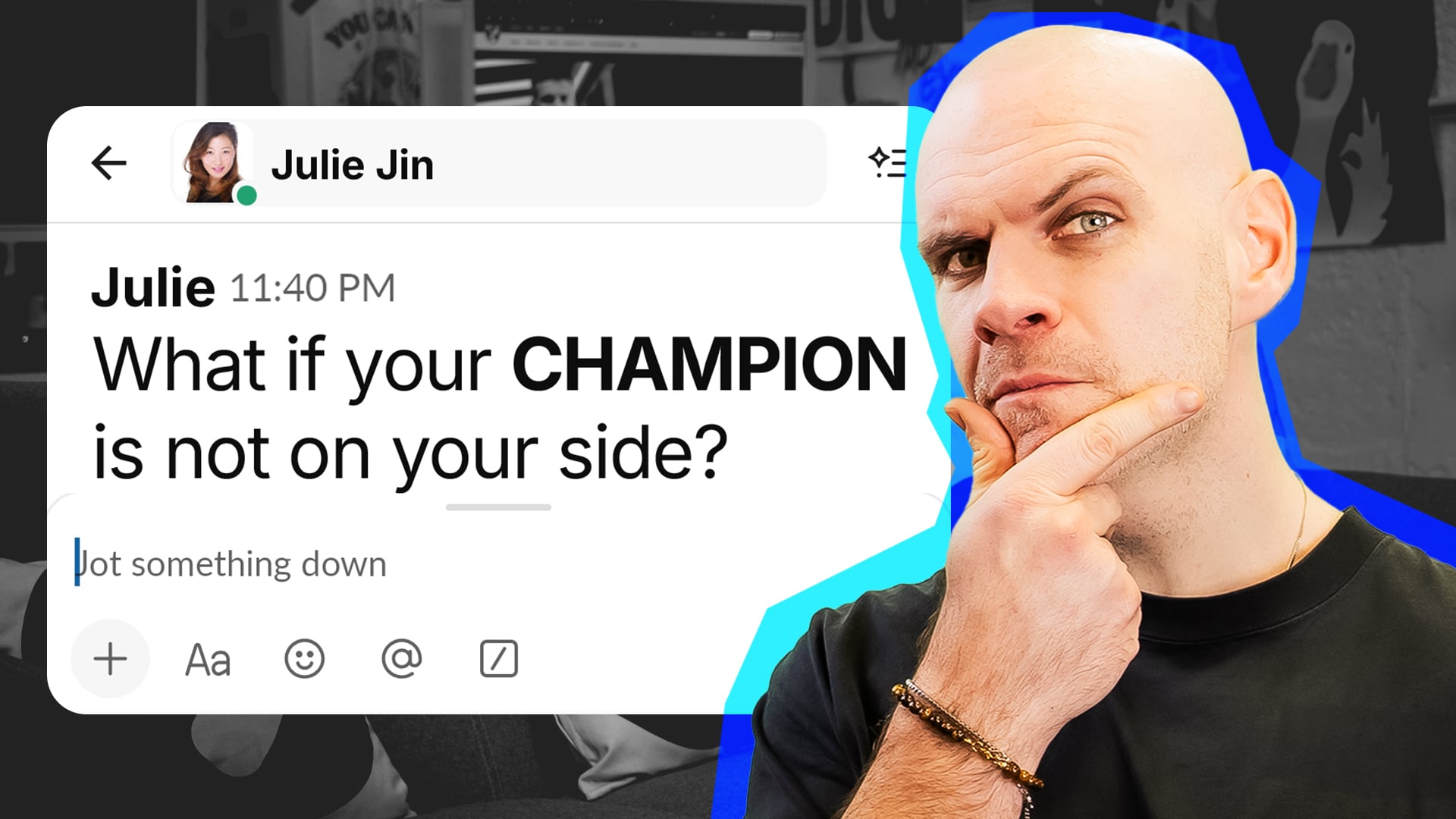
- One customer found that 89 percent of the deals they won in a quarter shared the same Champion persona, a persona they had actively kept sales away from because they assumed it was a detractor. Once they saw the data, they built the persona pages, collateral, and even a community they'd been missing, all because a Common Language let them see the pattern at all.
- The M1 to M3 progression turns one back-end value story into every front-end marketing asset. Jessica describes the pain, Decision Criteria, metrics, and Champion behind a win as the back end, which marketing, sales, and SDRs then reuse consistently across case studies, banners, and outbound instead of each team inventing its own language.
- MEDDICC's buyer's guide deliberately builds in reverse trap-setting Decision Criteria. The guide walks prospects through all three types of Decision Criteria, including ones competitors can't meet, so buyers arrive at conversations already primed to evaluate on MEDDICC's strengths.
.png?width=273&height=327&name=image%201%20(1).png)
Andy Whyte
CEO & Founder of MEDDICC
Andy Whyte has helped companies big and small grow and prosper as both a quota-carrying Account Executive and a Revenue Leader. His passion for helping sales teams succeed led him to become founder and CEO of MEDDICC and author the five-star-rated “MEDDICC” book. Known for his mantra “Nobody ever regrets qualifying out” and his expertise on the science and art of sales. Away from the day-to-day, Andy practices many skills as a chef, sports coach, taxi, and cleaner in his most important role to date - Dad.
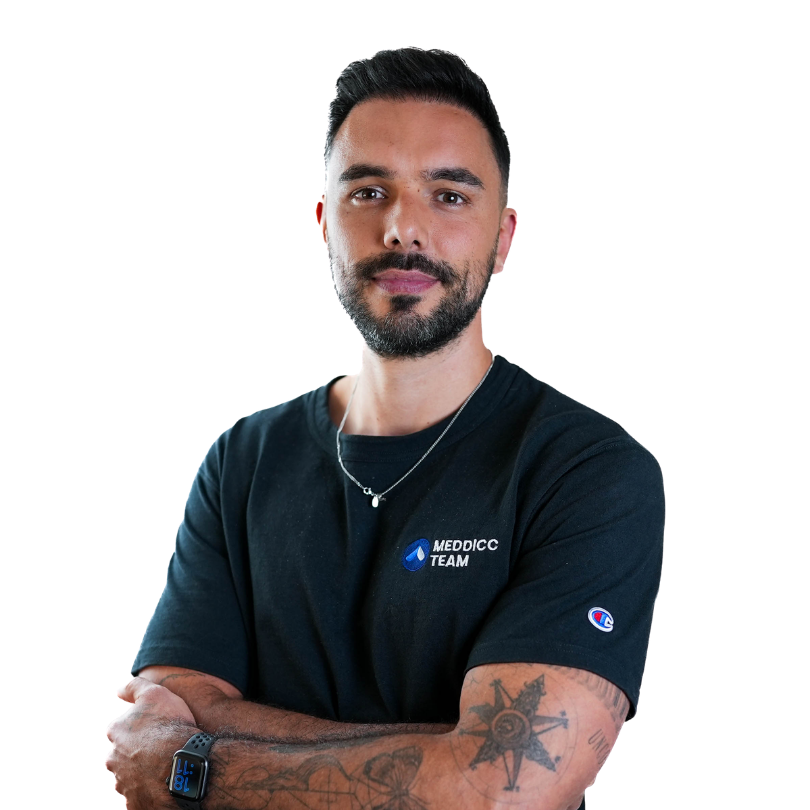
Pim Roelofsen
CRO of MEDDICC
Pim Roelofsen has over 15 years of experience in sales, having worked with leading tech companies. Before joining MEDDICC, he was a customer at Cisco Meraki, where he led a pilot to a successful global initiative. After using the framework as a top performer, then seeing the power of MEDDICC as a company-wide initiative, he came on board to help others drive transformative results with the framework. He is now responsible for the entire revenue function.

Jessica Walker
CMO of MEDDICC
Jessica Walker is Chief Media Officer at MEDDICC, where she leads on website, brand, comms and marketing strategy. She manages a team of talented media professionals responsible for building out the product pillar MEDDICC MEDIA. Jessica started at MEDDICC as Head of Marketing in 2022 and was instrumental in building its brand. Under her guidance,the MEDDICC Media team contributed to 99% of closed-won revenue. Marketing is her passion, and she’s on a mission to conquer it (in the name of MEDDICC).
Copy Full Transcript
00:08 Pim Roelofsen: Welcome to The MedMen Show. My name is Pim, this is Andy — 00:11 Andy Whyte: — and today we have a very special episode because we are joined by none other than Jessica Walker, our CMO here at MEDDICC. Welcome to the show, Jess. 00:21 Jessica Walker: Thank you very much. I'm very happy to be here. I feel like I've been asking to come on to The MedMen Show for about a year, so — thank you. 00:28 Andy Whyte: You're normally the other side of the camera! 00:30 Jessica Walker: Yeah, I know — it's a bit weird being in the studio setting. But I'm enjoying the setup. 00:37 Andy Whyte: Welcome. It's great to see you here. For those that don't know you, why don't you give us a brief introduction about who you are and how you got into marketing? 00:48 Jessica Walker: I'm going to keep it very brief. So — I hated marketing. About ten years ago, I thought it was just a career for people who spent a lot of money. They ordered pens, they had water bottles, they went to trade shows — they didn't really do any actual work. I was very naive. I started my career in construction and basically had the opportunity to move into marketing, and I realized the creative side of it was what I absolutely love. The brand aspect, actually talking to customers — I just realized there's so much more to marketing than what I originally thought. It's not just pens and water bottles. We do like to spend money. But we like to make money too. And now, obviously, I am CMO at MEDDICC. I've been here for about two and a half years. First time in SaaS and tech and sales — and before joining, I knew nothing about MEDDIC or Andy Whyte, which I feel is sacrilegious to admit. 01:54 Andy Whyte: Before we get into that — can we just double-click on one small thing you said there? You mentioned "media" — can we get into the difference between marketing and media, and how we think about that within MEDDICC? 02:16 Jessica Walker: Yeah, definitely. From a marketing and media perspective — marketing has gone through a lot of digital change, and you'll see it on LinkedIn all the time: everybody wants to be a media company. Media is a big buzzword. But how we treat it at MEDDICC is that media is this overarching umbrella — everything rolls up into that. So our marketing is just another form of media. We split it into two ways: we have brand, which is our long-term activation, and we have marketing, which is our short-term activation. But ultimately we function as an inside agency — MEDDICC Media — with marketing as part of that. 03:01 Andy Whyte: An agency. One client. 03:02 Jessica Walker: Yes. One true client. MEDDICC. 03:04 Andy Whyte: Love that. We're going to talk a lot about M's today — M for media, M for marketing, M for CMO, and of course M for MEDDIC. And one thing that ties it together is something that our friend JJ — the CMO at CrowdStrike — says. What does she say about the M in MEDDIC? 03:28 Jessica Walker: Yeah, I recall this day vividly — it was probably one of the best things I've ever heard, especially as a marketer myself. JJ described the M in MEDDIC as standing for marketing — M for marketing instead of metrics. Which I think was huge. To have somebody like JJ vouch so strongly for MEDDIC. And when you think about CrowdStrike as the brand they are — her top achievements probably include marketing and MEDDIC, the incredible work they've done in motorsport with CrowdStrike on the Mercedes F1 car, and a couple of Super Bowl adverts — no big deal. But JJ saying M stands for marketing is definitely one of my highlights of working at MEDDICC. 04:16 Andy Whyte: For sure. But I think it'd be interesting — the purpose of us getting together today is very much to talk about the M, marketing, in MEDDIC, and how it connects. Regular listeners and viewers will know that we like to describe MEDDIC as being a common language. And not just a language that's commonly spoken in the sense of "I know what MEDDIC is" — but a common language for the whole go-to-market team, for the whole customer lifecycle, which of course involves marketing heavily throughout. Coming as you did from the outside, right at the sharp end of this — what's it been like learning about the framework, the common language, and applying it to your role as CMO? 05:16 Jessica Walker: I think the first thing I'd say is: if you're a marketer looking at MEDDIC, go through the MEDDICC Masterclass. We're not reinventing the wheel. The framework you learn — MEDDPICC — it's different terminology to what you'd use as a marketer, but it's not anything new. And it can really tie in with things we already use as a marketing team. Any processes or methodologies we already use — MEDDIC just overlaps on top. The other thing I'd say is: when I first learned about MEDDIC two and a half years ago, I had a very different feeling to how I talk about it now. It's taken me a while to get up to speed. But the biggest benefit for me is that go-to-market synchronization. Pim and I are able to communicate so easily because we have this common language. That's the huge benefit — not just from a revenue or sales perspective, but with product as well. Taking what we already know as marketers and applying it across the go-to-market team through a common language is just enormous. 06:37 Andy Whyte: I love that. And I think the term "go-to-market" — it's not a new term, but it's flavor of the month right now. Everybody seems to be putting "go-to-market" in front of things that were formerly "revenue" and before that "sales." The classic example: the SKO became the Revenue Kick-off and now it's the GKO — Go-to-Market Kick-off. And it's a good thing — it's great for the industry because the more cohesive the go-to-market team is, the more cohesive the message and experience customers get. But the big opportunity with go-to-market lies in bringing the whole cycle together. And it's not just starting at the top of the customer funnel — I think go-to-market should start right back with the design and creation of the product. 07:26 Andy Whyte: We work closely in good organizations with product teams — the better the product team, the closer they are to the customer and the customer's problems. But what we know is that product teams often have to operate in the dark. They have to be proactive to go and speak to customers, actually get time in front of them to get information back, or survey and interview salespeople — and that becomes very subjective. What we love to think about is the full go-to-market cycle, starting with the product. Because ultimately the end of that lifecycle is making happy customers who renew with you, spend more money with you, and are genuinely happy. And MEDDIC starts there — if you're a product expert, you're going to want to know: what pain do our customers have? And when we are engaging and winning with those customers and solving that pain, what is the value they're getting? What are the metrics? What's the delta value? 08:41 Andy Whyte: But just as much as it's about seeing what's working, it's also about seeing what's not working. This comes down to decision criteria — the last ten deals we've won because of this one thing that differentiates us from the competition. Great to know. But likewise — what about when we lose? What are we missing? Can we feed that back to the product team so they can evaluate whether it's worth enhancing? And that's before it even gets to your world. But when it does get to your world — in a world without MEDDIC, that proposition comes through for marketers as: "We've made this new module, this new feature — go tell everyone about it." And marketing teams will do what they know best and apply really great work. The problem is they're doing it in isolation. Product teams have their own language. Marketing teams have their own language. Then it goes into customer meetings with yet another language — oriented around the salesperson's needs: "Is there a deal here for me?" And by the time the salesperson picks up, they've not got a great handover because we've gone from one language to another to another. Now we're in a fourth language. It starts to get a bit crazy. 10:05 Pim Roelofsen: Yeah, absolutely. And if we take that back to marketing in this context — in terms of our collaboration — you can see it in the resources your team is building. Whether it's a resource for a prospect, throughout that cycle, we can influence decision criteria right from the get-go. So that when someone first lands on our website and then gets in front of someone from the sales team, they're not suddenly speaking about something entirely different. It's about informing everybody in the go-to-market team, and across the various stages of the customer engagement model, to work in much more cohesion. Because if we know why we win and why customers decide to partner with us, and we infuse that back into resources and educate in a cohesive manner — everybody wins. 11:00 Andy Whyte: And in your example, you're also making sure that the buying experience isn't clunky or disconnected. 11:10 Jessica Walker: Fully disconnected. Because even if you have a very big pain as a prospect, and as a go-to-market team you have the best possible solution for that — it's still not a foregone conclusion. So as go-to-market teams, it's all about connecting to that whole journey. And what does that better than a true common language that everybody can tap into? So — a question to you, because you said earlier that from your previous experience, you were already using a number of things, so this isn't necessarily anything new. You'd typically connect back to value, stakeholders and process. What would be an example of that in your world before MEDDIC? 11:51 Andy Whyte: Yeah, I'm interested in this. The one obvious thing that comes to mind is use cases and customer stories — testimonials. As marketers we obviously want to use those as much as we can. The social proof. The proof of value that customers are getting exactly what we say. And it's more powerful if a customer is saying it versus us. Typically marketers get lost in really clever messaging about the customer, or it's about getting a glossy brochure with customers' faces on it and some nice quotes in big font. Whereas what has been — I hate this word — but a game changer since MEDDIC is all about M1s. We're doing a lot of work at the moment in terms of how we position M1s as a business and within MEDDICC knowledge. And that's all about bringing in decision criteria, pain, and the value we actually provide. The M1 story we have available to us at MEDDICC is bringing all of that common language and all of that resource from all the different go-to-market departments to actually talk about something compelling to the customer — rather than just "this customer really liked our product." 13:24 Andy Whyte: And there's something consistent about that too. I remember — it must have been earlier this week or last week — ahead of a session with one of our customers, we were on their website looking at their case studies. And it seemed as though every case study had a completely different format. So if you talk about the consistency of the buying journey and the experience a prospect will have — that was way off. And in itself, those case studies might still hold a lot of value, a big delta between the without and the with state. The ingredients were all there. But the way it was displayed in a cohesive manner was completely lacking. 13:59 Jessica Walker: Yeah. And that's not ideal for your prospect who is on your website going: "I know what I want to find here." If they're looking at case studies, they're trying to get a feel for what value you bring. They're probably trying to reinforce their instincts — their gut that says this is interesting to them. And I believe a lot of the time they're trying to arm themselves with the rationale as to why they should investigate or evaluate this solution further. So it's a bit like champion building — you want to help the person you're selling to become a mini salesperson for you, to empower them to sell internally on your behalf. So if they're on a website and on one page it's talking about the solution, then the next page doesn't mention the solution at all — and sometimes you go on a page that's got really solid metrics and sometimes the metrics are missing — it's harder for that person as an advocate to digest and communicate. 15:25 Andy Whyte: And that's just the customer. But let's think about the sales team. We have this view in our industry that the sales team are going to be walking, talking encyclopedias of our solution. And sure — sales craft is one thing, knowledge of the industry and product is another. But the average tenure of an AE is under two years now. So how long is it going to take someone to become an expert in a product? Surely six months to a year. So there's at least half of a salesperson's average tenure where they're not going to have all the answers. So set aside customer marketing for a moment — if you were able to pull together all of these great examples of value you've provided, but bring them into a cohesive common language that the whole go-to-market team can use and digest — everyone will use it differently, but they'll all use it. 16:27 Andy Whyte: My favorite way of describing how we talk about M1 is the technical analogy of the front end and back end of a website. The M1 in MEDDIC — in value and positioning — is the back end. It's the code. It's the pain we solve: without us, you have this pain and the implications of that pain — that very bad situation. We get that really concise. We understand: before the customer worked with us, without us, what was the situation? And then we look at the with-us state — what's the value they get? What's this utopia state they're enjoying? And then we look at the delta between the two states, and we're able to get some measurement of the impact. We also want to think about: if we wanted to take this to another customer, what would they need? What's the decision criteria? So we build that in — who cared, who was implicated, who was the champion, who was the economic buyer, who did we beat as the competition. All of those elements are really critical components of a value proposition. That's the back end. And then the marketing team takes that data and puts the front end on it — which could be a pull-up banner at an exhibition, a tweet, the headline on the website, a long case study, a white paper, a video. But the point is: it's all got the same back end. 17:48 Andy Whyte: And a great example of this is the buyer's guide we're working on right now. Why don't you talk a bit about the idea behind that and some of the MEDDIC influence that goes into it? 18:09 Jessica Walker: Yeah. I mean, the first thing I'd say is: we at MEDDICC are a startup. We're still building these things ourselves. So if you look on our website today, you might not see as many case studies as we want — we're still building them and still learning. And the buyer's guide is a great example of that. We've never had a buyer's guide at MEDDICC before. We were briefed by the sales teams — we have such a good relationship with them that they can come to us and say "we really need this," and we work out how to do it. The buyer's guide will live on the website as a downloadable resource. Essentially it's to provide prospects with information they need about implementing MEDDIC and what they should look for in potential partners. 18:55 Jessica Walker: Now it's kind of a win-win for us, because the document is armed with reverse trap-setting in decision criteria. Things in there that our competition don't have — we've put them in because we want prospects to go to our competition and ask: "Do you have this? Do you have that?" And find that MEDDICC does. So we've put those things in there. But essentially the document talks to the three types of decision criteria and has that reverse trap-setting built in. The idea is it's not a hard sell about MEDDICC and what we do — it's a guide for prospects to use. And then they've got all the information they need. 19:47 Andy Whyte: And I think the rationale for this document — everyone understands the purpose of a buyer's guide. But for us it's like we operate in an environment where MEDDIC is an almost open-source framework, which is a real strength. Not all MEDDIC is equal. And we've taken this framework and not just expanded its core function for sales, but proved it to be usable for the whole go-to-market team, as we've been talking about. So the challenge we have as a business — and one of the reasons why this buyer's guide is so important — is around decision criteria. A lot of our customers will be at an event that's normally at a quarter end or year end, things perhaps haven't gone as well as expected, and someone on the board will say: "You need MEDDIC, because all the companies that forecast accurately, don't have surprises, don't have deals falling off — they use MEDDIC." And so that person goes out to find MEDDIC and often comes with a limited understanding of the breadth of what you can get. They might talk to one organization that says: "Well, MEDDIC just tells you which bones are broken — it's not going to prevent you from breaking bones, and it's not going to help you heal them." Which is mad, by the way. And then they'll say: "You need this other thing and this other thing." Whereas we would say: "Actually, no — MEDDIC does all of that." And so the buyer's guide really comes into play there. 21:48 Jessica Walker: Yeah, absolutely. And that's kind of exactly what it is. It's got a top and a bottom to it, but the majority of it is about decision criteria. And if I sit here and think: how would we have put that document together if we didn't have MEDDIC as a marketing team? It would be very difficult. Most companies work with some sort of points of differentiation, but we've broken it down into the three different types of decision criteria. I just don't know where we would have got that information from without MEDDIC. 22:33 Andy Whyte: For me it goes back to something you said a while ago — as go-to-market teams, as sellers and as marketers, we need to stop thinking that our prospects are professional buyers. A buyer's guide is typically welcomed by someone who is serious about an initiative, because in our example they think "we need to do something with MEDDIC" but it's completely new to them. And that translates to the typical environment that our customers have as well. If you're in the SaaS industry selling any kind of technology, that's generally true. So it's very much a resource to help educate prospects, help them form their decision criteria — and yes, influence it a little. And make sure they can have that cohesive journey we've been talking about. The stat in the industry says most buyers are about 60% of the way through their journey before they ever engage with a salesperson. A resource like this will help them get there in a more efficient way and make that journey better. 23:50 Andy Whyte: And the other thing I was thinking about as you were talking — the influence of this common language for our team. We just had someone new joining your team, looking after demand generation. Shout out to Jen — immediate impact there. And aside from her craft and experience, MEDDIC as a common language really helped us accelerate her ramp time and empower her to make an immediate impact. I'll give an example through data — we want to make sure we target the right persona. So we need to make sure someone understands: what is a typical champion for us? If we go on to a tool like Sales Navigator, how do we set the settings so it's going to work for us? What is a good ideal prospect profile in our world? All of these things you can try to start explaining, but how are you going to do that without a common language like MEDDIC? And the typical companies we see — it's good if you do it within your sales team. But our best customers do it cross-functionally, across the go-to-market team. These are small examples, but they add up, and they add up fast. If you commit to the journey like that. 25:13 Jessica Walker: I feel like we're giving away trade secrets right now! But I want to give an anecdote. As part of The Marketing Unlocked podcast, I get to speak to CMOs within the industry about their MEDDIC implementation. And I spoke to Mondra at MRI recently — MRI is a customer of ours. And I think — I can't remember where the CEO called it their growth kick-off — was it Orlando? 25:37 Andy Whyte: In Orlando. Yeah. 25:40 Jessica Walker: Oh yeah — and he made me take a photo of Mickey and Minnie Mouse! 25:45 Andy Whyte: Yeah, I remember that. Yeah. 25:48 Jessica Walker: So — in the media team there are 13 of us now with the new addition of Jen. And if you split marketing and media, there are two marketing people in the media team. And in terms of products at MEDDICC, we have one core product — MOS — but if we break down the individual products we have, we probably have about ten things we like to talk about and publicize. And I was speaking to Mondra, who attended the growth kick-off and whose marketing team has gone through the Masterclass. Mondra is CMO globally and has a 125-person marketing team with over 110 products in their range. And for me — if I didn't have the common language and was managing that many people globally, that would be a massive struggle. But Mondra said MEDDIC has enabled her marketing team not only to work more efficiently from a global perspective, but also to work across the customer lifecycle. So they're now working with product directly as a regional marketing team in terms of managing those 100-odd products. It's massively beneficial. And we're seeing it across the industry. I can imagine for someone like Mondra, creating those buyer's guides and customer stories with MEDDIC as a common language is so much easier than trying to do it without. 27:28 Andy Whyte: Yeah, because it's like — there are other frameworks. Right. Which have a very purposeful purpose, but they don't tie together what we see MEDDIC tie together for the whole go-to-market team. That value piece — what problems we solve, what value we get from solving that problem, and how our solution does it — through to which stakeholders care about that value. Because one thing our industry often gets wrong — and I think it's the same in other go-to-market functions — is they think about pain as this kind of universal thing. Let's say, us as a company — CEO, CRO, CMO. If we bought HubSpot, I have a very different pain to solve by getting HubSpot than you do. Completely different. We might have some mutual ones — reporting, visibility, that kind of stuff — but our pain is completely different. 28:44 Andy Whyte: In this instance, it's likely that the HubSpot salesperson could be selling to either of you — maybe both. Now a great salesperson is going to have both of you as their main contact. But the point is: if the salesperson had met Pim and Pim is talking about how the current CRM doesn't have great reporting, the UI is not great for updating deals — and then came to you and said "we're going to give you a great forecasting update," you'd go "OK, that's interesting, but all I really care about is my marketing analytics and all of that." And people listening will get that straight away. And it's obvious. But how many websites could you go on right now where it would actually help in that situation to clearly separate between two people who are buying the same solution but have completely different pains? It's the same in the sales cycle. So that idea of value being the first pillar is really important — but it directly overlaps stakeholders, in terms of who cares about what. And then the next pillar is process, because different stakeholders are involved in different parts of the process, from the very first bit of interest through to managing the relationship with the customer you've won. Those three pillars — they overlap, they're like a Venn diagram, constantly shifting. 30:13 Andy Whyte: And it's the same for the sales process as it is for positioning as it is for market research. It's the classic old-school marketing: right message, right person, right time. It's value, stakeholder, process. They just overlap perfectly. 30:35 Jessica Walker: Yeah, absolutely. And I always love the persona part of marketing with MEDDIC. Back when I was doing marketing before, it was so nitty-gritty in terms of personality — where the person shops, what car they buy, all of that. And realistically, none of that really matters. But if you go on our website now — and I keep using our website, I promise it's not a big sell — something I'm quite proud of is we're starting to build out these persona pages. At the moment there are four pages and we want to build it out for the entire go-to-market team. As a marketing team, we've been able to use our own process — the three whys — combined with MEDDIC. So we've identified sales enablement leaders, individual contributors, and CRO as our top three personas. What pain do they have? They all have separate pain. They're all looking for something different to solve for. And that's a big part of what we've been able to do with MEDDIC from a marketing perspective. 31:46 Jessica Walker: My favorite anecdote on this is one of our good customers — a company somewhere between 100 and 200 million, well-established, great company, one we look up to in a lot of ways in terms of their positioning, marketing and execution. They told us that after their first full quarter — Q4 — of having MEDDIC implemented with us, they were reviewing data on the deals they'd won. And they said that in 89% of deals they won, when they broke down the data on what persona cohort the champion fell into — not necessarily a job role, but a persona — it was the same one 89% of the time. Basically nine out of ten deals, the champion was this particular persona. Which is mega. 32:47 Jessica Walker: But what was also — and this was a bit of an OMG moment — was that they realized they didn't have any persona marketing for this persona at all. And it's not because they don't have strong persona marketing — they're very, very good at it, one of the best I've seen. But they didn't have any marketing for this persona because they incorrectly thought this persona was bad for them. They saw this person as a detractor — they slowed deals down, they weren't fans of their solution. So they had been proactively discouraging the sales team from engaging with them. There were even anecdotes of sales accepted leads not being accepted because of that. And of course without the common language — because champion isn't specific to MEDDIC as a concept, but it is at MEDDICC, because our customers have a very clear criteria for what a champion is: they have to have power and influence, a vested interest in success, and they have to be selling internally. Every champion qualified the way we implement MEDDIC will have a very clear criteria. So they could say very strongly: the champion is this person. 33:58 Jessica Walker: And the good news from this story is that being the great company they are, they were able to flip it around. I think they've even built a community for this particular persona — which they wouldn't have been able to do without MEDDICC. There's no way they would have known to. You wouldn't have been able to capture that data at that scale. 34:26 Andy Whyte: Such a cool story. And I'm immediately thinking: is there a persona like that for us that we're currently not reaching? And this is the beauty of it — because we use it proactively, but it can also be used reactively to look into data. We've done that internally — looking at what we can do better. And it can be part of something like that. But for me it goes back to the inability to do these things if you don't have a common language across the go-to-market team. And you said something earlier — not your exact words — but it's like: it's not rocket science. And similarly, the best salespeople and go-to-market professionals, once they go through our programs, they would say: "Oh yeah, this is how I already used to engage with customers. I just didn't know there was a name for it." And that's a pretty big part of all of this. Because if you think about some very talented people in an organization — all good. But as long as they keep using different languages and different ways to communicate about, well, the three pillars — you're never going to unlock the potential to do things like what you just described. 35:54 Andy Whyte: Yeah. I think one of the things that's interesting is we've been talking quite high level, at the strategic level. But I'd love to zoom in a little and hear about some of the things your team has been doing to get more tactical with using the language — to maybe inform some of the decisions you make, the activities, the campaigns you promote. I'd love to hear if that's something you're doing. 36:20 Jessica Walker: Yeah. One of the things I was just thinking about — and I think this ties into your question — is that it's not specifically down to marketing, but it comes back to having a culture of trust and actually implementing MEDDIC the right way. In terms of visibility and data — knowing where to go and look for it, and having the relationship to be able to speak to the CRO, speak to the sales team, to the AEs and ask them and find these things out. As a marketing team, we can't just sit back and expect this information to be delivered to our door. We need to be working with the rest of the go-to-market team to find it out. So one big thing we've implemented in the media team — and Pim can back me up on this — we've started attending new business meetings with customers and prospects. Because you want to find out these different personas, these different pain points, what people are looking for. And typically the people we have those new business meetings with might come in with one pain and leave with three. That can inform our social messaging, our website messaging, our campaign messaging. 37:39 Jessica Walker: And then obviously we've been joining the deal reviews as well. We are huge believers in deal reviews. But we've not limited that just to the revenue team — the whole company is invited to deal reviews. And it's a big thing for the media team to attend those too. Not only are we more aware of what's happening from a revenue perspective, but we're thinking: how can we immediately support what's going on? Is there a blocker we can help with? Is there something we could do better in our messaging that might prevent this from happening again? Is it something like the buyer's guide? So just being very tactical with how we spend our time. That collaboration is super important. 38:27 Jessica Walker: And the other thing — a big structural change we've made recently: we've brought our SDR into the media team. I've never had an SDR reporting into me before, so that's all new. But it's kind of bridged the gap between the revenue and the media team. So yeah, there's lots we're doing at the moment. 38:57 Andy Whyte: Yeah. And the age-old debate about whether SDRs should report into marketing or revenue — there are obviously pros and cons, but for us the why comes down to our organizational setup. And I think this will be more of a thing if people embrace the full potential of MEDDPICC — the go-to-market function just becomes so much more cohesive. The idea of an SDR reporting into marketing actually makes a lot of sense because all they're basically doing is saying: "Thank you, marketing, for building this brilliant, easy-to-understand proposition that really illustrates what pain our solution solves, gives me great examples of where we've done that — the without-us state, the with-us state, the utopia that happened afterwards and how we do it." So they can now very easily lift that across with our MEDDIC value proposition — the M1, M2 and M3. That's perfect. Because via an M1 — which is basically our value proposition made up of pain we solve, how we solve it, the decision criteria, the value in solving it, the metrics, and who cares (champion, economic buyer) — who did we beat (competition) — it's this beautiful encapsulation of a use case, a success story. You can give that to an SDR and they can go and talk to all these companies knowing that message resonates. You give it to a channel person because they say "I want to be introduced to this organization — here's why, here's this perfect little anecdote of why that organization should talk to us." In a language that the channel person and every person in go-to-market understands. It just makes everything so much more cohesive. So of course it makes sense for the SDR team to report into marketing — because they are just an extension of it. They are just a channel of marketing, which makes perfect sense. 40:55 Andy Whyte: And then the issue that people are rightly concerned about — where SDRs wouldn't report into the sales function because of a communication gap — of course, if you have a common language really working, there is no gap anymore. Everyone's just together. People like to use the relay race analogy of passing the baton. Well, there is no race — because you're running in lockstep together. There's no baton pass. You're all in the same line, just passing it from one person to the next. So that works really well. 41:32 Andy Whyte: What about what you were telling me the other day — you and your team were looking at opportunities in MOS to inform what you felt was needed. You said something about looking at opportunities in MOS? 41:53 Jessica Walker: Yeah. So we're very lucky in the sense that we get to use MOS on a daily basis. That's where we have our opportunity manager. But from a media perspective — and again it comes back to this culture of trust — we're not going in there to check whether the sales team have filled things in, whether they've actually put an M1 in or some metrics or decision criteria. We're not going in to check if the sales team have done their job. We're going in to look at how it can inform what we're doing. So not necessarily needing to have that face-to-face time with the sales team — we can go into this open platform and find that information out for ourselves. And there might be stuff in there we haven't thought of — a different decision criteria that we could add. And guess what? We can now add that to the buyer's guide. So for us it's really important to be on top of that and keep an eye on what's going on within MOS. 42:55 Andy Whyte: That got me thinking of something. The learning in MOS — and some research I was doing recently — I was recording a new program and looking at best practice for education screen layouts: where should the presenter stand relative to the overall screen? And I went down this rabbit hole looking at — I won't say the company name, but household names, universities, colleges, supposedly some of the best online education entities there are. And I came out thinking: I'm sure the level of education is high, but in terms of engagement — I find this so boring. It's so plain. There are no stories, no anecdotes. It doesn't come to life. And it made me come back to you and say: you know we always talk about our biggest strength when customers are comparing us to other MEDDIC training companies — it's how engaging and rich the content is. We've always felt that because we get that feedback. But I had never taken into account just how low the bar is for the whole education industry. And what that told me was: from a decision criteria perspective and a pain perspective, our prospective customers are going to have a much lower opinion than I thought of what online education looks like. So we had this conversation: in the buyer's guide, we need to make sure we highlight how important it is, from a buyer's perspective, to have highly engaging content. 44:39 Andy Whyte: Because we make that joke about our competitors' videos being like airline safety videos. I'd thought that was just something we'd say — "let's go have a look at the competition, yeah that's not very engaging." But it's bigger than that, isn't it. And why this is important to this conversation is because I was just able to say to you: the pain that our customers are likely to come in feeling about on-demand training — a pain that doesn't even exist until you mention to them that the training is on-demand and they go "oh, I'm not sure about that, because everyone just thinks of those security and onboarding videos." So I was able to relay that back to you. You both understood immediately: this is the pain. And therefore the negative metrics being that people don't watch it, don't engage with it, don't learn from it. And therefore the decision criteria needs to be: highly engaging. You were able to go: "Yes — that needs to go in the buyer's guide." And in everything we do. So it's just a common language. And just in how we were able to talk about that one thing. 45:44 Andy Whyte: And to your point, your team goes into MOS as well. They pick up on things and get inspiration as to what they should be building. So if you look at the media team — they get ideas like "we should produce content out of this because it will be useful in educating prospects and in a sales cycle with a customer." So Ellie, who's behind the screens today, would reach out to the entire revenue team to make sure we capture content exactly for that purpose. These are two very specific examples of where a common language, with a system underpinning how you bring it to life, is really empowering the go-to-market team to pull together. And again — I feel like we're going to sound like a broken record — but to truly create that cohesive experience that keeps getting better every day. 46:33 Jessica Walker: What's really cool about what you've just said is that by the time this episode launches, we'll have our new ad out. And after you brought that pain to Pim's attention, we decided to create an airline safety video ad comparing our content to Doofus Airlines. So I'm really excited for that to come out — you'll be able to see it at the same time as the episode! 46:58 Andy Whyte: Love that. But what I'd love to wrap up with is — you as a senior marketing professional, with tons of experience, your podcast talking to other CMOs — what's the thing you would say to a CMO or marketing professional tuning into this? Maybe they've heard about MEDDIC or their company is considering it. What would you say to give them confidence that they're on the right path by evaluating MEDDIC? 47:23 Jessica Walker: I think a lot of marketers will get this, and maybe other departments might not like what I'm about to say — but in my opinion, marketing teams should own the customer journey, because they touch so many different parts of it. And as a marketing team, how can we support the entire go-to-market team if we're not speaking the same language from awareness right down to renewal or advocacy? We need to be touching all of that. And if we're all working with different methodologies, different frameworks, different languages — if I'm speaking French and you're speaking Spanish and someone else is speaking Portuguese — we're not going to understand each other. So if your company is looking at MEDDIC and you're a marketing professional right now — embrace it. Because you can still do everything you're already doing, but with so much more cohesion. 48:21 Pim Roelofsen: In my mind, I was just going to say — there was a scenario where you and I would have our daily morning catch-up and I would just be speaking Dutch and you'd be speaking English. And the conversation doesn't go anywhere. That's kind of what it can feel like if you don't have the common language. 48:36 Andy Whyte: What happens every morning? I mean — it's a little wrap-up there, but it's a really great final point. I hadn't heard you say it quite like that before. And this idea of the customer journey — if we really zoom out: at the start, product doing very manual research with no information loop happening. Then marketing picking up that product and proposition and applying best practice to make it pop in the customer's mind. Then the sales motion starts with SDRs trying to take what marketing has put together and turn it into outbound. Then channel trying to make a different company dealing with loads of different propositions understand it. Then the sales team picks it up — and if you listen to some advice in the industry, the sales team has to go from one methodology to another framework to another language. And the customer is left thinking: "Hang on — these people are all talking different languages." And then the handover to Customer Success — in my experience, that doesn't happen often, let alone well. And then staying engaged post-sale with the important stakeholders, remembering the real reason why they implemented the solution, the pains being solved, the value they've promised — all of that. It's just these islands of disconnected languages. 49:59 Andy Whyte: Whereas what we're saying is: we capture the value we can bring, capture which stakeholders care about that value and why, and go: "Right. This is the value. This is life without us. This is life with us. Here's the value between the two, here's the delta. Here's how we do it — decision criteria. Here's who cares about this." There you go, go-to-market team — use that back end as you wish, make it into your own messages. By the time it gets to the sales team, there's an interested prospective customer — and they're interested because they've been told about these M1s, these use cases. So the salesperson goes: "That resonated with you — I can see why. Let's personalize these to your situation. Let's make this about you now." We make it about them. We build the business case — the M2, the personalized value story. We work with the customer, get that consensus, make sure they believe in this proposition as much as we do. We win the deal because we've partnered with them. And the M2 turns into an M3 — exactly the same thing as an M2, but now it's our job — mine and the customer's — to deliver on the goals we set for ourselves. 51:32 Andy Whyte: When we achieve those goals together, we may set new, higher goals. But the most important thing for the go-to-market team is that the M3 that's been achieved and confirmed goes all the way back to the start — to inform the product team: "This is why we're winning." Informs the marketing team: "Here's another example of why that use case resonates in the market — add it to the M1, let's get more power, more anecdotes behind this." And so it just builds up momentum. The more M1s you create, the more M2s you create, the more M3s you create — you get this cycle flowing round and round. Nothing I've said there will be alien to any marketing person listening to this. None of those ideas are tactics they haven't thought of before. What's been missing is a common language focused on the whole go-to-market team to bring it together. And that is why I am as excited as I've ever been about the MEDDICC Metric Value Program — it's just around the corner. And I've got so much to thank you for, for your insights of how you work day to day, and the people you've introduced me to — your peers who have the same experiences and challenges that we are ready to solve. 52:52 Andy Whyte: So yeah — I feel like I just got on a soapbox there for a bit! 52:55 Jessica Walker: Is that normal for any of your podcasts? 52:57 Andy Whyte: It's because you're marketing — we're getting a bit into the plug! But — what do you think? 53:01 Jessica Walker: I think it's going to be amazing. I'm really looking forward to MEDDICC Metric Value. When's it out — come on, when's it happening? 53:07 Andy Whyte: Well, I'm working on it. We're close. We're weeks away — I'll commit to that much. Weeks away. And it's very, very exciting. But with that in mind, we better get back to it. 53:20 Jessica Walker: Yes. Thank you very much for having me. I hope it's not going to be another year before I'm back. 53:25 Andy Whyte: Oh no — that's it. You're a regular feature now. And I have to say — you've nailed it. You're the Peggy Olson of today. Thank you very much. 53:31 Jessica Walker: Now don't shame Pim's outfit! 53:34 Pim Roelofsen: What's wrong with my outfit? 53:37 Andy Whyte: I'm joking. OK — let's wrap up!
No transcript sections match your search.
This is a lightly edited transcript. Some sections have been condensed for readability.
ABOUT THIS EPISODE
SHOW
THE MEDMEN SHOW
EPISODE
S2 | EP 6
DURATION
54 mins
PUBLISHED
2024
Video
MEDMEN
MEDMEN Season 2
CHAPTERS
00:48
Intro & Jessica Walker's Path to CMO
02:16
Marketing vs Media: How MEDDICC Thinks About It
03:28
M for Marketing: What JJ at CrowdStrike Said.
05:16
MEDDIC as GTM Synchronization
08:41
The Language Problem Across the GTM Cycle
12:00
M1s Are Not Case Studies, They're the Back End of Every Campaign
18:09
The Buyer's Guide and Reverse Trap-Setting
31:46
The Persona Discovery That Changed a Customer's GTM
36:20
Marketing Attending New Business Meetings and Deal Brainstorms
41:53
Going Into mOS to Inform Marketing Decisions
44:39
The Airline Safety Video That Became an Ad
47:23
What Jessica Would Say to Every CMO Considering MEDDIC
49:59
The M1 to M2 to M3 Flywheel
GET MORE MEDDICC IN YOUR INBOX