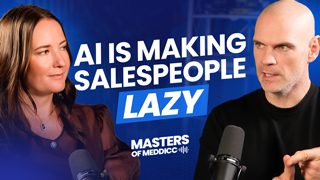
00:00 Pim Roelofsen: Welcome to The MedMen Show. My name is Pim, that's Andy. And today we are talking about three things that will help you uncover more metrics. Three things — three P's. The first is preparation. The second is proactivity. And the third is having a point of view. 00:19 Andy Whyte: Here's the thing with metrics — we hear this all the time. People find it a challenge to get metrics because what they're doing is engaging with the customer and trying to uncover numbers that quantify the value their solution can bring. But customers are not experts in our solutions. Even if the salesperson does a really good job, the customer may not even know they had a problem. So the idea of them knowing how much that problem is costing them, and being able to work backwards to come up with numbers, is pretty hard. This is where the three P's come in. I think this is very recognizable — because if you've ever had that conversation internally with colleagues or your team going "what are their metrics? How should they know? They're not professional buyers of your solution" — that's always the difference between us and management consultants. Consultants charge huge amounts — sometimes millions — to go into an organization and basically help them come up with metrics and a plan for a solution. They don't even provide the solution, just the plan. And we as salespeople, if we're really switched on, can do the same. That's what consultative selling is. But we have to help our customers get there. 01:33 Pim Roelofsen: So — and just to be clear, these three P's are not a McKinsey-esque approach that will take years to put together. It starts with the first one: preparation. Before you engage with that customer, put some time aside — not an hour, I'm talking 20 minutes — to think about who this customer is, what kind of business they're in, what challenges they're likely to have, and how your solution can help them solve those. Start to build a point of view of what value you can bring. Look at your existing customer base — customers that are similar, customers that are likely to have the same kinds of pains, the same kinds of use cases you'd want to deploy. You prepare with a point of view, and then you take that point of view proactively to the customer. 02:35 Pim Roelofsen: So: we prepare, we come up with a point of view, and then we proactively engage with the customer in a consultative manner. "Mr or Mrs Customer — I was doing some research ahead of our meeting today. I was looking at organizations I think are similar to yours. I was reading your annual report, doing some research online, talking to your peers." Whatever it may be — the point is: I've done my research, and from that research I've formed a point of view that I'm now going to bring proactively to you. From a customer perspective — what a wonderful thing. They've invited you in because they recognize either they have a problem they hope you can help solve, or they recognize you as someone that brings value to organizations like them. And then within seconds of meeting them, you're getting straight to the point: not only do you have value you can bring, you're confident about it because you've done your research. And you get into a real conversation. This is professional discovery. It's going in with a point of view, going in with research — not going in with a PDF you downloaded from some self-professed guru on LinkedIn with questions like "what keeps you awake at night?" and "who else cares about that?" Customers hate that. This is consultative selling. 04:15 Andy Whyte: Yeah. I think with the preparation piece, the only thing you really need to commit to as a seller is the time. Because doing the preparation and collecting the information you need has never been easier. It's very easy to find out what a company is talking about, what they're saying in interviews or on podcasts, how they make money. Just ask an AI — ChatGPT, or as our CTO would say, Claude — to give you a summary of some of these things, do some of your own research, and 20 minutes goes a really long way. 04:54 Andy Whyte: I will say though — and this is maybe more of a personal preference — there's real magic in doing the work yourself. If you just say to ChatGPT "I'm meeting with the CTO of Stark Industries, my solution is this, what might they care about?" — that's table stakes now. Everyone's doing that. You turn up and look like the last person who asked the same question. But the real magic happens when you do the work yourself. When you're reading the research, going around the internet, reading things, watching things — your brain makes connections. "Oh, I wonder if that's like this." You go in lots of different directions. You get a much broader, richer point of view — one you'll feel more confident in because you found it. You'll be more authentic because it's genuinely your point of view, not the same answer given to everyone who asked the same question. So I am a bit of a stickler for going the extra mile here. And some people get upset if you tell them to spend more than 20 minutes preparing for a meeting that could make their year — which is kind of funny, when you think about it. 06:17 Pim Roelofsen: Yeah. It's funny, but also that meeting has taken a good amount of effort to bring people together in the first place. So preparation really is table stakes. And I do agree with the personalization piece. What you're describing is also a fast track to building champions — because if you look at it from their point of view: what are you looking for, as someone in a business trying to solve for something? A trusted advisor who can help you do it. So if you come in with a point of view, with a proposed path — even if it's not perfectly aligned with what they're looking to do — they're thinking: "Hey, this might be someone who can help me achieve what we're looking for." 06:58 Andy Whyte: Spot on. And the beautiful thing is: you're right, it's going to help you build a champion. But even better than that — this way of building a champion signals to that person: this salesperson came in well-researched, intelligent, credible. They understand. They bring value. I'm really pleased I met them — I got value from this conversation. And if I introduce them to my boss, it's going to make me look good for finding them. So you get that easier introduction to the economic buyer and other people in the business. It all comes together beautifully. 07:33 Pim Roelofsen: Absolutely. And the way we make this possible for our customers — because metrics is of course the M in MEDDIC — is through MEDDIC Value and the go-to-market triangle, which starts with an M1. That's what we're talking about when we talk about coming in with a point of view. In our world, an M1 is the crystallization of value from a use case. We take a use case, look at the pain it solves, look at the value we get from solving that use case, look at the metrics that measure the delta between the two, and look at the decision criteria the customer needs to deliver that value. That's a use case. You could have multiple M1s to introduce to a customer. And when you're doing the preparation, you're learning about the customer's goals, the strategies supporting those goals, the initiatives underpinning those strategies — and you start to think: which use cases do I have that can support this customer? How can we strategically align with their goals? That's how the M1 comes in. You'll have multiple ones — some confirmed with existing customers, some that are hypotheses of value. And we also include in the M1 which persona it's applicable to, so we can think: the champion is going to really care about this part of the M1, whereas the economic buyer will care about the more economic dimensions. That model is how we make it much more efficient for our customers — to find those points of view in use case, story and value form, so that starting those conversations becomes very easy to prepare for, very easy to be proactive with, and very easy to bring a point of view to. 09:18 Andy Whyte: Absolutely. When you do this, it gets you away from the situation of "OK — what are their metrics? How are we going to indicate the value our solution will bring?" Because if you end up in that situation, the typical result is that the deal doesn't happen and you keep seeing inertia and indecision from the customer. Whereas this makes it very effective to do discovery on the front end — to be very clear about the impact your solution will deliver. And we all know: value combined with pain is what drives real urgency. That's where urgency lives. 09:54 Pim Roelofsen: Here's to the three P's! 09:56 Andy Whyte: The three P's — cheers!






































.png?width=273&height=327&name=image%201%20(1).png)