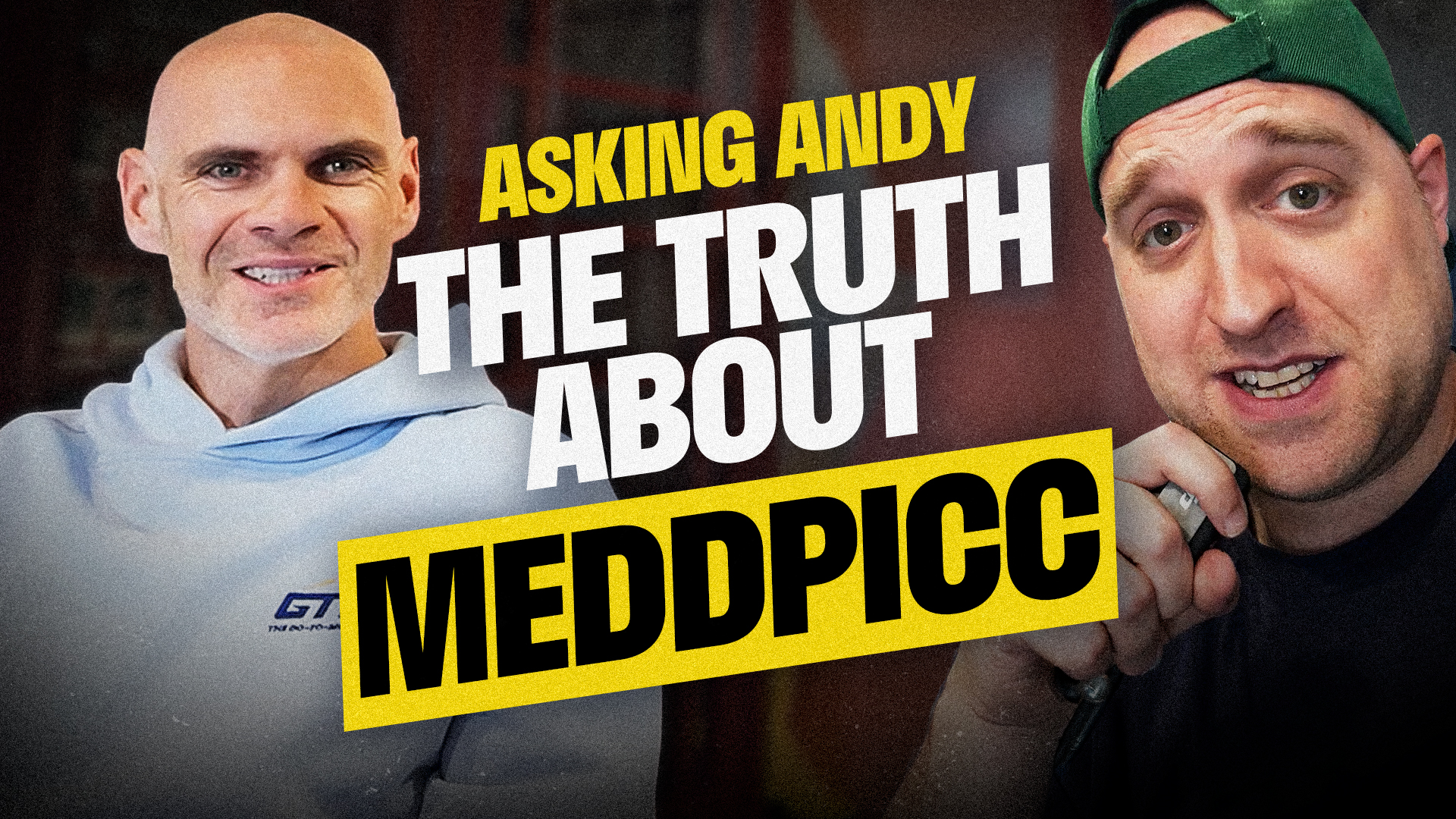
00:00 Pim Roelofsen: Welcome to The MedMen Show. My name is Pim, and that's Andy. 00:03 Andy Whyte: What are we talking about today, Pim? 00:05 Pim Roelofsen: Today, Andy, we are talking about the importance of being proactive on decision criteria as well as stakeholder engagement. And we're doing this through a real-life situation — where we have bought one solution and, by the time this episode goes out, may have bought another. So two buying experiences from the customer side. 00:26 Andy Whyte: Yeah. And for me the headline is: even if you have the perfect scenario within a deal — you've received a big brief as a seller, you already have a champion — it doesn't mean you can just sit there and the deal will fall into your lap. 00:39 Pim Roelofsen: So the context here is: we hired a new CEO, Julie. Hi, Julie. Julie came in with a wealth of experience, looked at some of the things we were doing, and said there's a huge opportunity for us to unlock better experiences for our customers and more efficiency internally by implementing a customer success tool. 00:58 Andy Whyte: Yeah, absolutely. It essentially underpins our customer journey with rigor so that customers get the value they buy into. 01:07 Pim Roelofsen: And so Julie doesn't just say this — she says "at my last company we used a solution, we'll call them Vendor A, and it's exactly what we need." She then talks to us about it. And in this case, instantly I'm the economic buyer and Julie is a champion. Not just a champion for Vendor A — she's a champion for the initiative. So everything from my perspective is: OK, this sounds interesting. Her goal then is to go and engage with Vendor A. And she brings you in too, Andy — classic champion behavior, bringing in the CRO as a potential stakeholder. Tell me about your experience. 01:54 Andy Whyte: Yeah. So first and foremost, I have a vested interest — on the basis of which I become a champion of the initiative. Not so much Vendor A or B specifically, but the initiative itself. Because for me, one of the strategic goals we have as an organization — to which any seller could have attached themselves — is to have a solution like this, to be in a better position to drive recurring business. Simple as that. So my experience was: OK, I'm in here now, but I'm not really being engaged or built as a champion. I'm just receiving information and seeing what they do. 02:31 Pim Roelofsen: Yeah. That's such an important distinction — we don't perhaps talk about enough. This idea that you're a champion for the initiative but not the vendor yet. What would a vendor have to do in that situation to make you their champion? 02:44 Andy Whyte: Connecting their decision criteria — the way they do things uniquely or better than anyone else — to whatever I'm trying to achieve, the pain I'm trying to solve for. And whilst that was obvious, if they'd done proper discovery it would have been clear. They just didn't. So I remained a champion for the initiative — but that was based on what I was able to figure out myself, without any help. 03:10 Pim Roelofsen: Yes. So we'll give Vendor A the benefit of the doubt — maybe they felt they didn't need to differentiate that much because Julie had bought from them before and was clearly acting as a champion: giving them insights, sharing information, literally briefing them as a customer. It's a dream scenario for a seller. We'll give them that benefit of the doubt. But what then happened? Why are we talking about this at all, as opposed to just: they gave us a price and we bought it? 03:45 Andy Whyte: Yeah. I think we were looking at two solutions to benchmark — to see what else was out there, whether there was a better way. That came from me as the economic buyer thinking about the economic side of things. I wasn't asking Julie "is there a company with more integrations?" or "better bells and whistles?" I was saying: for no other reason than when we enter into negotiations, we need a secondary economic benchmark. So that, I think, is why there was an openness to potentially finding a better vendor. But from my perspective, that's why. 04:24 Pim Roelofsen: Yeah, absolutely. And this is a key point — if you think about the economic buyer, it's not the technical decision criteria they're focused on. It's the economic decision criteria. Because you didn't even get involved in any demos. 04:34 Andy Whyte: I literally saw the product for the first time yesterday — and that was maybe a month after we signed the contract. 04:39 Pim Roelofsen: Yeah — it's already implemented. But to your point: as an economic buyer, you don't care about bells and whistles. You're higher up on the value pyramid. You're thinking about: how can we provide better experiences for our customers? How can we be more efficient? How can we make sure we don't miss things? All the things a customer success platform does at the higher value level. And from a buying process perspective, you care about the three C's: costs — and not just the price of the solution, but the resource costs. Completion — how likely is this to succeed? And confidence — leaning heavily on Julie as the champion to validate whether this is definitely going to be worthwhile and whether we could spend our resources better elsewhere. 05:32 Andy Whyte: Yeah. Confidence was the big one. If you or Julie had said "we need to do this," it would have been done without any more questions from me. But even though we had that confidence, what did I care about going back to costs? Not just the price — but whether we were getting a good deal. And my experience of buying all the technology we've bought over the last four years is that what's presented to the economic buyer as the best and final price is never the best and final price. I've always managed to get much better terms. So my pushback to you and to Julie was: I think we can do better. And the way I suggested doing that was to bring in Vendor B. 06:04 Andy Whyte: And by this point, Vendor B had come in and done an OK job — but hadn't differentiated themselves on decision criteria. They were just presenting. Like-for-like, slightly better on stakeholder engagement — but that's about it. Pretty much from a technical perspective, we were going by what Julie knew she needed because she'd used a solution like this before. So in my mind, I was saying: use Vendor B as a negotiation tool. And I fully expected — if you'd asked me to bet £1,000 on what would happen next — I would have said: we sign with Vendor A, and we've managed to get better terms. 06:45 Pim Roelofsen: Well — we actually ended up going with Vendor B. 06:47 Andy Whyte: Yeah. And the thing is, there was no differentiation through decision criteria as we discussed, there had been no proactive stakeholder engagement, no attachment to strategic goals. And therefore the result was quite simple — it came down to price. Vendor B came in significantly more interesting from a pure price perspective, and we all said that platform is going to do great for us. And that's how the decision was made. 09:00 Pim Roelofsen: Yeah. And I think the bottom line is: price-bombing is not selling. You might as well just say "what's the best price you've had so far? OK, we'll do 10% less." You don't need salespeople to do that — it's pure order-taking. So the inverse: if there was a scenario in which either of these vendors had attached themselves to our customer retention goals — the whole essence of a platform to help with that — and engaged proactively with me as the economic buyer, a very different scenario would have been possible. 09:36 Andy Whyte: Yeah. And just doing a more solid job of attaching to the vested interest of the champions they could have been building — I was right here. Julie would have introduced me, if nothing else. And if they didn't go through Julie, they could have come directly to me. They didn't. 09:53 Pim Roelofsen: And this brings me to the point about the second solution we're in the process of buying — a completely different product this time. Vendor A in this new process: the first I ever heard of them was when the founder and CEO sent me a very well-thought-out email saying "it seems like you're looking at our solution — I'd like to offer my support as an executive sponsor." And then what happened? 10:25 Andy Whyte: I went straight to Slack, into the leadership channel, and said: "Wait — who is Vendor A?" And everyone was like: "Oh yeah, we've been looking at this." I wasn't precious about it — I was just curious. And we started dissecting the email, as sales-minded people do. It was a classic economic buyer opener. In theory, nothing wrong with a CEO-founder reaching out to me. Then their CRO did the same. It shows the power of proactive EB engagement — but the champion work they'd done hadn't reached me yet. They hadn't empowered Jess, our CMO, to engage me and tell me about it. They weren't that far along, or hadn't built Jess as a champion enough to inspire her to involve me by that point. 11:21 Pim Roelofsen: Yeah. This is super interesting because we talk about multi-threading as a best practice. But to just do EB engagement without mobilizing your champion to make that land in the right context — it can be a dangerous game. In this case it doesn't necessarily hurt their chances, it just creates a bit of a "wait, what is this about?" moment that you then have to clean up. But there can absolutely be cases where you initiate multi-threading and it backfires. I'd always go back to: collaborate with your champion. Their vested interest will make that engagement important to them too, and they'll help you do it much more effectively. 12:07 Andy Whyte: Agreed. I will say — because of how well-thought-out the email was, I did hold a small amount of goodwill towards them. I was also a bit curious because they didn't mention Vendor B in their email — "I see you're also looking at Vendor B." I thought that was actually the right call. The classic line: don't think about the competition, focus on your strengths. And by the way, inertia is probably a bigger competitor for them than any other vendor. So yes — they should absolutely be focusing on the value they can bring. 12:43 Andy Whyte: But then the same thing happened. We met here yesterday and Jess, our CMO, presented the plan — this was the first time I was formally hearing about it. She did a great job; in fact she built a metrics map to present, which is quite impressive and probably a topic for a future episode. And as I understand it, we're currently leaning towards Vendor B. We may have made a decision by the time this goes out — but the point is we're in the same scenario as the other buying process: neither vendor has really worked with us to inspire differentiation into our decision criteria. We're finding our own way and going "that vendor seems better for us." But should Vendor C appear on the horizon — I don't know what unique differentiation Vendor B, our current vendor of choice, has to defend. I feel like Vendor C could just turn up, say "we do everything they do and we're cheaper" — and suddenly they've built pipeline off the work Vendor A and Vendor B have done. 13:49 Pim Roelofsen: Yeah. The dependency you see in these cases is that we're almost hoping our buyers will figure it out on their own — be professional buyers and make an informed decision. And sure, we'll do some of the work. But even with three genuine champions in a business, a deal that looks perfect on the surface is not a foregone conclusion. 14:20 Andy Whyte: Exactly. And just to name those three champions — because in this second scenario, there's you as a champion with a revenue interest, Jess as a champion with a marketing and media interest, and Julie with an operational interest in what the solution will bring. Three genuine champions. And in the case of Vendor A — should I tell you a small secret? I haven't heard from them yet as a potential economic buyer. You'd think they'd be straight onto me. But apparently not. Let's see if that's changed by the time this episode comes out — I'll keep you posted! 14:59 Pim Roelofsen: I'll drink to that! 15:00 Andy Whyte: Cheers!








































.png?width=273&height=327&name=image%201%20(1).png)