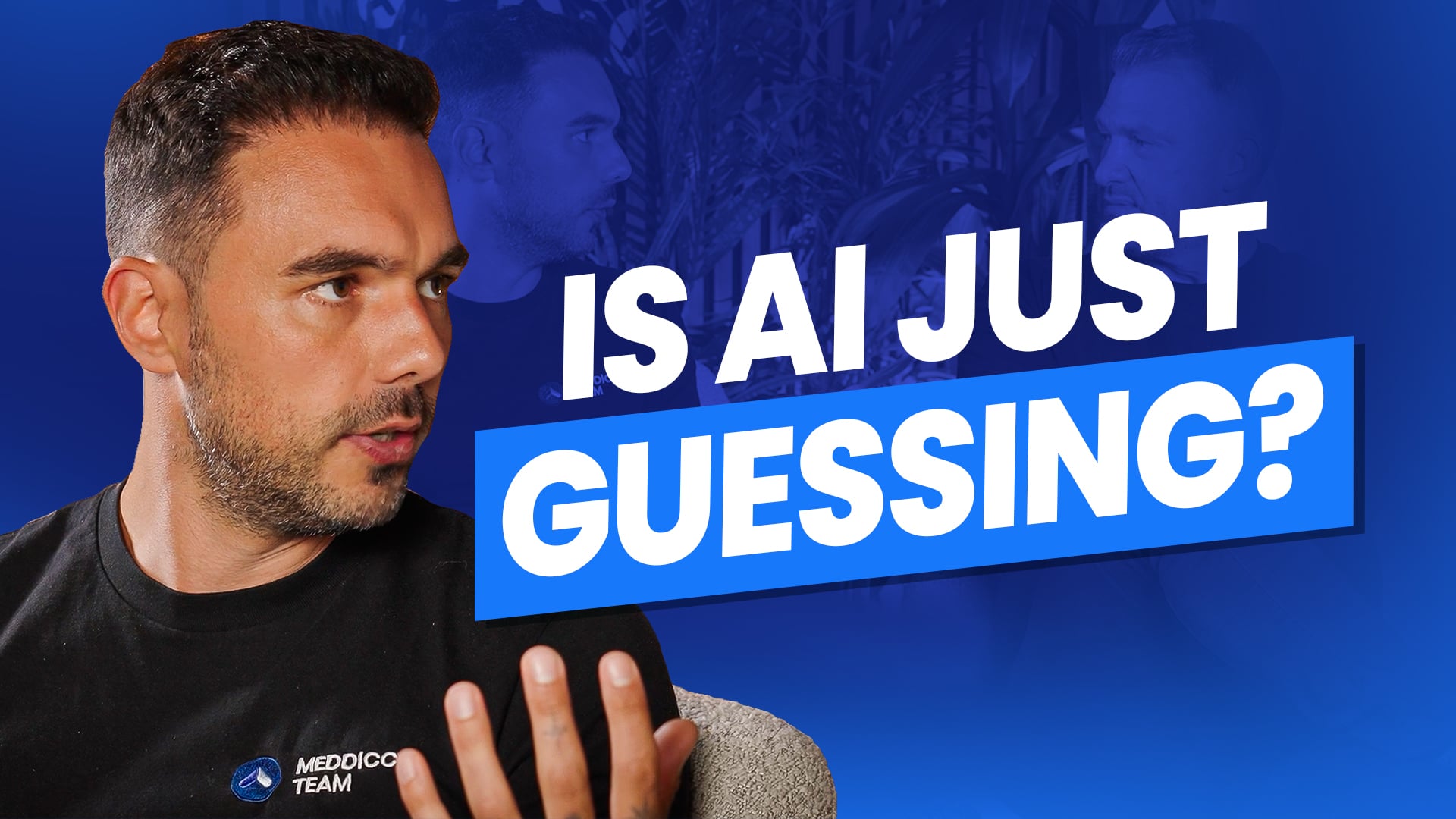
00:00:00 Julie Jin: Sheryl Sandberg said, "If you get a ticket on a rocket ship, you get on that rocket ship." 00:00:05 Andy Whyte: One of the things I was so interested to talk to you about was how you apply MEDDPICC as a buyer. 00:00:10 Julie Jin: Tell me why your solution is better and can help me achieve my goals better than anybody else. And I want to do it quickly. One demo, done. I want the value, not the buying process. Why is HR, or changing our HR tooling, a top priority? For me, I don't think we ever really answered that. I knew why we needed to do this. At the end of the day, I also want to minimize the risk. 00:00:35 Andy Whyte: Welcome to Selling To. I'm here today with our COO, Julie Jin. Hey, Julie. Julie's got an interesting story, because she's not only a buyer of many solutions and technology, but you were once an account executive yourself, Julie. 00:00:49 Julie Jin: Yeah, that's right. It's a funny story how I got there. Probably one for another day. 00:00:53 Andy Whyte: Okay, okay. Not something you wanted to go into, sales, but something you found yourself doing. 00:00:58 Julie Jin: Yeah, that's right. So I have a background in finance and consulting, and of course I've done services sales, but I'd never done tech sales. But I had the opportunity to join an up-and-coming startup that had just received a lot of money, and Sheryl Sandberg said, "If you get a ticket on a rocket ship, you get on that rocket ship." So I went in, in whatever role they needed, and at that point it was account executive. And I was like, "Well, okay, let's do this." And I joined as an AE. 00:01:23 Andy Whyte: I love that. I love that. And I guess the thing is, you probably learned a lot of things in that role that help you as a COO today. 00:01:31 Julie Jin: I think you learn it to whatever extent in consulting, but never so structured. I feel like in sales you learn about positioning value. I think communication's also very important. Prior to joining sales, I didn't really respect the craft of it. And then, having done it myself, it's so much process, discipline. It's so much repeatable success as well, once you know the process. But before you get there, it just kind of feels like you're scrambling, just talking to people without really driving to any outcomes. 00:02:05 Andy Whyte: And I can't believe I've never asked this before, but did you use MEDDICC? 00:02:10 Julie Jin: I would say we tried to use MEDDICC. I bought your book; that's actually how I first heard of you. And we did implement some things from MEDDPICC. But seeing it done here now, we were worlds away. 00:02:24 Andy Whyte: Yeah, well, that's one of the really interesting things, and the reason I was so excited to talk to you, because you're now on the other side, buying all kinds of technology. I think we were just totting up, and it's something like ten different sales processes in just over a year. Buying processes, I should say. So, the other side to it now. And one of the things I was so interested to talk to you about was how you apply MEDDPICC as a buyer. Any time we've bought anything, the first thing I've known about you meeting with a salesperson is you giving me a MEDDPICC briefing. You're saying, "I met with this vendor," and decision criteria is basically the primary one, where you're breaking it down. And that's fascinating. Tell me about why you do that. 00:03:05 Julie Jin: I mean, in the end, any time you're purchasing something, you're trying to solve a pain, right? I feel like I'm preaching to the choir here. So the first thing I want to do is share the metrics we're trying to move. What's the strategic value I see in bringing on any solution? Then I want to share with you the rationale: how I got to this recommendation, why this vendor versus the others I evaluated. And then, depending on who the EB is in that situation, I'm either asking you for a go/no-go, or just letting you know, "Hey, we've made the decision, and if you want more details, this is the rationale behind it." 00:03:43 Andy Whyte: Yeah. And that's honestly the best experience for me, because I get a real insight into what the rationale is straight away. And, perhaps unlike most economic buyers in this case, I have a little bit more of an interest in the tech, because I'm a bit of a geek, but also it's our industry, right? I'm always interested to see what our peers are doing with positioning and selling and all that good stuff. So it's great to see how you frame it. But let's zoom in on a few of these, because there are some really interesting stories I want to share. I don't think you'd been with us for a month before you said we needed a CSM platform, a platform to manage the success of our customers. And I remember you saying, "But it's all good. I've got some experience here. At my last place we bought Planhat, and it does exactly what we need here. Let's get them in." And I said, "Sounds good. I back you. This makes total sense," with the rationale you'd put to me. But I said we should talk to somebody else as well, just so we could get a comparative idea of commercials and that kind of thing, and make sure we weren't missing anything. What happened next? 00:04:46 Julie Jin: It felt like a repeat of what I'd done at my previous company, in the sense that I went out and built a long list of vendors, and a lot of them I'd already spoken to. We brought a newer player into the list, called Vitally. And I laid out my decision criteria: the economic, the technical and the relationship criteria. And in the end, they came out very comparable. I had my relationship criteria for Planhat, to be very honest. But when they came out comparable like that, I basically went on price. It was a very easy decision. 00:05:18 Andy Whyte: Which is, you know, something we hear so much in sales: "We lost on price." It's almost like a catchphrase in sales. The reality is, if you lost on price, one of two things happened. Either you're selling to a not-very-smart buyer, right? 00:05:36 Julie Jin: Okay. 00:05:37 Andy Whyte: Don't worry, I'm not saying that's what happened here. That's where they've just made a decision based on price, and value isn't part of the equation. Or, as I think is our case, they hadn't differentiated the solutions. So what you end up with is two comparable solutions, from our perspective, and it's like, "Well, why would you pay more?" And if I remember rightly, what we did was go to the one I think was perhaps your favorite, because of the relationship decision criteria you had from before, and say, "Hey, this other organization has come in and made this commercial offer to us. Can you match it?" And they said no, and we said, "Okay, we'll go down that route, then." I don't know to this day, and you probably know more than I would, but there could well have been something in that solution that would have been worth the additional amount. But the point is, we don't know. And the only way we would have known is if we'd uncovered it ourselves. Because this is really what it's all about for us when we talk about value selling, consultative selling. 00:06:36 Andy Whyte: The great salespeople, their job is to go and understand the business and what they're trying to achieve, then map backward from there to the decision criteria, and find how their solution can provide ideally unique value, or if not unique, differentiated value, in that the way they do it is better. So we can say, "We want to spend more money on this." And we just didn't have that in that situation. It's scary, isn't it, when you think about it? Because I've done this so many times as a salesperson, and we do it all the time: you have great success with a customer, and then that customer, our champion in many cases, leaves the business and goes somewhere else. Is that the case with you? And then they land and go, "Oh, this is great, but what we really need is what I had before. That would help me so much more." And there's arguably not a better situation for a salesperson than when a lead comes in and it's, "Oh, this customer bought us at their last place, and they want to bring us in." There's arguably no better scenario. And to lose a deal like that is painful. 00:07:37 Julie Jin: It's painful. 00:07:38 Andy Whyte: It should be painful. But it should have been avoided. And if I zoom in on this situation, I can remember now: you presented to me, "These are the solutions. They're both kind of in the same ballpark." And I went to you and said, "Because they're so close, I feel like we can nibble a little bit more here." And Vitally came back and said yes, and Planhat said no. And the point being, neither of those parties... I think I might have said this to you, actually, right? 00:08:02 Julie Jin: You did. 00:08:03 Andy Whyte: But neither party had made an impression on me. And I'm wide open to that, more than anyone. I'm literally the guy who preaches about engaging the economic buyer, right? So neither party had. And I feel like if they had, I might have had some favoritism toward one of them. 00:08:17 Julie Jin: So I think part of the challenge here was that I was also so new to MEDDICC, right? So I understood the pains at a high level, but I didn't really have enough context to understand all of the pains of the users, or of Pim, the one who actually owns the function. So I was evaluating on very high-level technical decision criteria. Whereas if the salesperson had gone in and maybe engaged more users, like the CSM team, they could have painted a better picture and actually influenced the decision criteria, like you said. 00:08:48 Andy Whyte: Yeah, exactly. That's it. That's the game changer. And with that, let's fast forward to, I think, the most recent investment we've made: Orama. 00:08:58 Julie Jin: Yeah, yeah, yeah. 00:08:59 Andy Whyte: So, Orama, an executive search firm. And what's interesting here is that we went from not entertaining the idea of working with any kind of recruiters to being all in with arguably the top end. And I've got to give credit to the Orama team. Talk to me about what happened, how we ended up where we are, and the journey from you perhaps suggesting to me, "I think we might need to look at getting some help here." It's basically gone from me walking to work, to you saying I might want to get a bicycle, to somehow ending up getting a helicopter to work. That's what it feels like, in terms of how we evolved to where we've chosen to go. So yeah, tell me about that. 00:09:45 Julie Jin: Yeah. So we've been looking for a head of services for a while. Originally we thought, "Okay, let's do this in-house. Our team has a great network." I was also using our outreach platform to reach out to potential talent en masse. We weren't getting the right response rates, or meeting the right people. And so we started to look at who could help us: "Let's work with recruiting firms to increase the funnel." So I went out and spoke with a couple of go-to-market specialists, and they all came in similarly priced. And then you recommended Orama to me, like, "Have you spoken to these guys?" "No, I haven't." So we had one conversation with them. The rest were here in terms of price. Orama was up here. In the end, I think it was very clear. We have a big pain to solve, right? So the higher the pain, the more willingness to pay. And they also really differentiated on how they would solve that pain. So from a technical decision criteria perspective, they really differentiated themselves, and through just a single conversation, maybe two, they were able to prove they could fill this role not only faster, but better than their peers. 00:10:57 Andy Whyte: Yeah, it's amazing. And if you think about it, so often in sales, salespeople are dealing with this scenario. If you look at BANT, for example, the first letter of BANT is budget. So if anyone had BANTed us for this, they would have ruled us out as any kind of serious buyer, because we had no budget. No budget set aside for this, no plans to do it. I think many companies will probably concur with this: there's almost a maturity curve, or some sort of realization you go through, where you've had a lot of success, as we have, and you're sat here as an example of that, finding great people without using recruiters. Then you get over that bump of admitting to yourself that you need some help, and then go from having no budget to, like I said, the Rolls-Royce of headhunters, of executive search firms, it seems to me. But it doesn't matter, right? 00:11:49 Julie Jin: I mean, it only matters in the context of the value that's being delivered. So for us, if I think about us going another quarter without somebody in the seat, how much is that costing our business, versus how much am I willing to invest? 00:12:08 Andy Whyte: Yes. So, the cost of inaction. 00:12:10 Julie Jin: Yes. Right. 00:12:11 Andy Whyte: That's what we're talking about there. From a sales perspective, it's a term that's probably used once every 10,000 times somebody talks about pipeline generation, or objection handling. If we were to make it more common in how salespeople think, I think we'd see a lot more success, because the cost of inaction is such a tangible cost. If you can connect it to a goal the organization has, and then put a cost on them not achieving that goal, often that's not just enough to create budget, it's enough to create urgency as well. Particularly in this case: while we have someone not in a seat, it's not that we're not running that part of the business. So it's not even just a revenue question. It's a resource question, of people being stretched to do those roles. So you can see why it's so important. But again, if Orama, or the person you spoke to there, hadn't pulled on that thread, the number they put in front of us might have just seemed untenable, because we would have been looking at it not from a value perspective, but from a cost perspective, which is kind of scary. And it made your job easier as well when you were trying to convince me. 00:13:26 Andy Whyte: Because, I mean, you didn't just come to me, right, and say, "This is my recommendation." I think I almost fell off my chair. 00:13:33 Julie Jin: I thought you might fall off your chair. 00:13:35 Andy Whyte: Yeah. And I think the way we agreed on this, and I'll be very public in saying this, is that we follow the Jeff Bezos approach of disagree and commit. 00:13:46 Julie Jin: Yeah. 00:13:47 Andy Whyte: Yeah, yeah. And I spoke to you and said, "Okay," because I wanted to hear from you how confident you were. And you were very confident, and not just confident for the sake of it: you were confident because you had the tangible decision criteria, and in this case the metrics, to really back it up. And so I felt, as an economic buyer, I could give you that go. We talk about the economic buyer's three Cs, right? Cost, which is often the sticking point. Completion, which, again, was part of Orama's economic decision criteria; they build in the completion. And confidence, which is the third. And you had the confidence, so I didn't have to have it myself. I could almost have it by proxy, off of you. So that's an interesting one. 00:14:33 Julie Jin: Yeah. I mean, at the end of the day, I also want to minimize the risk, right? With some of the other firms, it just seemed like, yes, they could help us, but it wasn't a guarantee, and it wasn't a guarantee that we'd get the best person rather than just somebody in the seat. So I think, yes, we're paying a premium, but we're also reducing the risk for us as a business. 00:14:54 Andy Whyte: And that's economic decision criteria, right? But again, that's something you have to uncover. Those other firms might have had different commercial models or approaches that could perhaps have solved it for us the same way, but they just didn't uncover that as a need we had. So that's interesting. When we think about the many solutions you've bought, which ones jump to mind? Were there some other interesting stories here? 00:15:23 Julie Jin: Well, I like Rippling quite a lot. 00:15:25 Andy Whyte: Yes. 00:15:26 Julie Jin: Because that was a consolidation, right? We went from our HR platform... 00:15:30 Andy Whyte: Talent management. 00:15:31 Julie Jin: Yes, talent management, and also our payroll provider, into one platform. 00:15:36 Andy Whyte: Yeah, yeah. 00:15:37 Julie Jin: Oh, and also all the EOR providers as well, like Deel and Remote. 00:15:41 Andy Whyte: Multiples of those. Sorry, I forgot about those. So what I love about this for Rippling is that this is Parker Conrad, the founder and CEO's, vision of what he calls the compound startup. I think they call it the employee graph. The idea is you have just one ID for an employee, whether you're hiring that person, as talent, whether you're paying them, or whether you're managing them, in an HR approach. In our case, we've got people around the world, so EOR is the system of record point. So his vision came to life. But what he might really love about this, and hopefully, Parker, maybe you'll get to watch this, is that we're a 50-person company. I'm sure when he set his vision, it probably matched the larger organizations in their ICP. But here we are as a 50-person company where, like you say, we consolidated so much tech. But the point there is, and I think I'm right in saying this, the HR provider we moved from could do all of those things as well. 00:16:42 Julie Jin: I think not the EOR. 00:16:43 Andy Whyte: Not the EOR. But we had another provider in place for that. 00:16:47 Julie Jin: Yeah. 00:16:48 Andy Whyte: So that's really interesting. But EOR wasn't the factor that made us move, right? That was almost a bonus, to make it make more sense. 00:16:56 Julie Jin: Yeah. I think the main technical criteria here was integrating different platforms, versus just having one single source of truth, right? So yes, while we could do talent management, HRIS and potentially payroll through the one platform, if we wanted to connect EORs, or contractors, we would then have to split out into multiple platforms and integrate them, which is just painful. And then, surprisingly, the all-in cost was also lower than having all of the different providers scattered. So I think it was a no-brainer on this one, to me. 00:17:43 Andy Whyte: Yeah, that makes total sense. But I do remember, post signing the deal, we were talking about this, and I didn't realize... I'd imagined, because I saw Rippling as a superior solution to all the other solutions we had, that we were going upmarket. So I anticipated the license cost would have gone up a little bit, and I knew there'd perhaps be some consolidation costs. So I was pleasantly surprised when you told me we'd actually saved money here as well. And I questioned you on what that process looked like, and you actually told me the salesperson hadn't really built that business case for you; you'd built it internally. Which feels like a massive miss, a missed opportunity. You were basically doing what we preach as great selling: helping build business cases, building that kind of business value assessment, different things for different people. And I think I actually reached out to some of the sales leadership team at Rippling and said, "Hey, by the way, we've got this. Do you want to see the business case we built internally?" I don't know if that email ever got thrown up. I'll give them the benefit of the doubt that it never got delivered. 00:18:43 Julie Jin: But, yeah, I mean, maybe I'm too nice to salespeople. Because in some situations, and I think some of the reps will validate this, I will literally send them the MEDDPICC summary from our side: "Hey, here are the metrics we want to move. Here's the EB. Here's who the champion is. Here's my decision criteria." And then they're like, "Oh wow, this is so great." Okay, great. How do you use that now, not necessarily to help you win the deal, but to help me make the best decision, right? If you know my decision criteria, help show me why your thing stands out over all the others. I guess I kind of have a cheat code with MEDDPICC, in the sense that I know what I want as a buyer, because it's so structured. I think you could use it in selling and buying, to be very honest. And I'm very happy about it, because it makes decision-making so easy. You know what value you want. You know what your criteria are. So there are no feelings or vibes. It's just very logical. 00:19:43 Andy Whyte: Yeah, yeah. This is something I get in trouble for when I say it. I don't think people like it when I say this, but typically our customers don't enjoy buying from us. 00:19:52 Julie Jin: Yeah, I know. 00:19:53 Andy Whyte: It's terrible, isn't it? No buyer gets out of bed in the morning, no COO gets out of bed in the morning, and goes, "Oh, right, I'm meeting an HR tech provider. I can't wait to have another demo. I've had three already this week, and I've got another demo. I can't wait to get stuck into it." But buyers do want the upside they get from the solutions, obviously. And so what buyers are looking for is an efficient and diligent experience. And what better way to give a customer a diligent and efficient experience than to focus in on the value? What pain are you looking to solve? What goals do you have, and how can I show you how I can provide value toward those goals? From a buyer's perspective, if somebody comes in and says, "This is what you should be basing your decision upon, not just from a technical perspective, but here's how this makes sense from a business model perspective," the economic decision criteria, "and here's what you should look for from a partner, here's what we bring to the table from a relationship perspective," you're making it a really great experience, because those are just the value elements a salesperson brings. 00:20:58 Julie Jin: Yeah. 00:20:59 Andy Whyte: And I can understand how this could be abrasive on the stakeholder side of things, where the salesperson knows they have to bring other stakeholders in. Customers have probably had bad experiences of salespeople going rogue, or perhaps they don't feel confident that salesperson is going to reflect well on them to the rest of the business. They haven't won the credibility yet. But really, if everything is right, if that customer is interested and you've done a good job, and you have credibility and trust in the eyes of what should be your champion, then helping that person get the support of other people, just like you've talked about getting my support and Pim's support for things you've bought, is a good thing. And here's the thing we forget. Even though you've bought lots of technology, that's because we're a growing company. Most people we sell to aren't experienced at buying technology, right? They don't do it a lot. And so by the time they need to buy something else, the process has probably changed internally. Salespeople sell all day. They see buying processes all day. They're experts in selling and buying. And so a great salesperson can help a customer accelerate that process, to get through some of the things we typically see slow this down. 00:22:09 Andy Whyte: So really, what we're saying here is that it can help the buyer to have the framework that helps them have that diligent and efficient process. 00:22:16 Julie Jin: Oh, I love that you say that, because I was thinking about why I would send a rep the MEDDPICC elements, right? Why do I even bother? Because it takes time out of my day. And it's because I want to shorten the sales cycle. I don't want to waste time on a discovery call just getting to the basics. I want to dive deeper into the metrics. I want to dive deeper into certain criteria. Like you said: tell me why your solution is better and can help me achieve my goals better than anybody else. And I want to do it quickly. One demo, done. I want the value, not the buying process. 00:22:52 Andy Whyte: Exactly right. 00:22:53 Julie Jin: I would love a rep to reach out to you, to Pim. But I worry that the outreach is going to come off more unprofessional than build my credibility, right? It's not that I don't care about the rep's credibility, but I care about my credibility, and the trust you have in me, more than I care about their credibility. And so their actions are a reflection of me, in a way, right? Am I running a solid buying process? And the person I'm speaking with is a reflection of the vendor, right? Am I speaking with a serious vendor, where the team is well trained, they're communicating well, and they have the professionalism to reach out to other executives? That's what I care about when reps are reaching out. It's not, "Oh, just go say hello to the CEO." No, it's, "Hey, how are you helping me sell this internally for you, and making my buying process easier?" 00:23:45 Andy Whyte: Exactly that. That's exactly it. The thing I often talk about is that if you're talking to, let's say, a champion or potential champion, that person is judging the salesperson on exactly what you said: "Are you going to make me look like I'm doing a good job or a bad job?" And there are layers to this as well. One of the beautiful things that can happen is that I can actually make you look good. So I'm selling to you, and I can make you look good, not by going around you, talking to someone else in your business and saying what a great job you're doing, though that does work. But from the perspective of empowering you to sell on my behalf, right? And that doesn't mean, if I'm selling for Rippling, you walk into the office wearing a Rippling T-shirt and give everyone Rippling cupcakes. That's not what I'm talking about. Let's go back to the Rippling example you're talking about. For us, and I know it's relatively small in the grand scheme of these types of things, it was a transformation. We were transforming the HR part of our business, and I had lots of trust in you for that. But that may not always be the case, right? 00:25:04 Andy Whyte: And so what I'm looking to you for in that situation is the economic buyer's three things I mentioned earlier: cost, confidence and completion, meaning how long it's going to take to be done. So if I go back to me being the Rippling salesperson: if I can empower you to really confidently answer those questions. And perhaps we could also throw in the Three Whys here. Why are we investing in transforming our HR back office? Why is your preference Rippling? And why, of all the things we could be doing, should we be doing this now, given we've got these platforms, nothing's broken, everything's working? Disrupting your team, who are going to have to do a lot of work on this. Everyone in the company is going to have to do new payroll, new logins, all that sort of stuff. So, answer those questions. If I, as the Rippling salesperson, can empower you to answer those questions, either formally or informally. What I mean by that is, I can literally sit down with you and go, "Typically, your boss, or someone like that, will want to know these Three Whys." Or I can inspire it more subtly, by putting it in a deck or something like that, and giving you the story that makes you look great in front of your boss, right? And that's just answering the questions. 00:26:14 Andy Whyte: What about if I, as is the case with Rippling, actually have an innovative approach, right? Like we said, they have the employee graph. They're the compound startup. They've got a new way of doing things. They're at the cutting edge of what they do. So for me, as the economic buyer, because I'm far away from it, my point of view might be, "Well, I just want the best HR system, and if we can save some money, or get a better UI, whatever it is..." You can come to me and say, "Actually, I've learned in this process, let me tell you about how this great organization is doing it." You look great. You look well researched. What's bad about that? Only a good thing, right? 00:26:47 Julie Jin: Yeah, yeah. And it's so funny you mention that, because in situations where I'm the EB, for example, and I'm looking at a proposal on my desk, what I'm looking for in a proposal is not just the cost. Like you mentioned, of course we look at the value and we look at the cost. But you're mentioning areas like the opportunity cost, not only of the dollars I'm spending, but of the time the team is going to spend implementing this new thing. I think when you're selling, you're very single-minded. You know everything about your solution. You know the value it can bring, but it's often disconnected from the context of the business, right? Why is HR, or changing our HR tooling, a top priority? For me, I don't think we ever really answered that in the Rippling conversation, but I knew why we needed to do this. 00:27:37 Andy Whyte: Yeah. Yeah, that's it. And from my point of view, it certainly wasn't a priority. I remember, prior to this, when we were using a different HR platform and a different talent management system, two different systems, I remember thinking, "Well, surely it makes sense to bring them together." And obviously the preference would have been the HR platform we used, which had talent management. I remember even approaching people there, saying, "Hey, the team loves your platform, and they're not that fond of this other platform. Should you...?" And they missed the opportunity there. I'll be honest and say I'm glad they did, because we're in a much better place now. But that's a strange one, where, as a customer, I'm sort of doing that John Travolta meme: "I thought I made it clear there was an opportunity for you to do an upsell to an existing customer, but you seem to have missed that." 00:28:31 Julie Jin: Well, and it's so funny you mention that, because at the end of the day, think about the risk the seller is carrying from this perspective, right? You were the EB in this situation, and I was the champion. If you didn't think this was important, you could have easily seen the proposal and gone, "Okay, there are some cost savings, fine. But why do this if it's not a strategic priority?" So if I had missed that piece, and hadn't prepared that piece, it would have just been a flat-out no. You could have easily said, "We're not doing this, because it's not a strategic priority." And I'd have been like, "Well, no, it actually is, because of all these things." But I don't think we had that conversation. It wasn't like Rippling was having that conversation with me and then helping me present it back. 00:29:20 Andy Whyte: Yeah. Right. Okay, this has been awesome. I'd completely forgotten what a wonderful experience, from a learning perspective, the Rippling buying process was. Before we wrap up, I have one question for you. It's my favorite question to ask in this type of scenario. What is the one thing, or it could be a related set of things, that you wish salespeople did more when they're selling to you? 00:29:44 Julie Jin: Oh, it's going to sound very basic, but just really understand what strategic priority is driving this, because without that, I think there's just no way you can support my buying process. 00:29:56 Andy Whyte: Yeah, exactly that. I remember there's this common objection you get, where the customer just wants a demo. And if you've got a complex solution, as many of our customers have, a demo could take hours to get from one end to the other. So you'd end up handling that objection by saying, "To give you a demo, it's going to take six hours, and I don't think you've got time for that. So what I want to do is get to know your business a little bit more." And I always think of that objection as something that shouldn't really exist. I think it's because the salesperson is rushing too quickly into discovery, into what I class as one-sided discovery, rather than point-of-view discovery. It's basically a discovery where I'm just trying to extract enough information from you so I can play back to you what I think you want to hear, rather than working with you to form a point of view. That takes you on a journey, takes me on a journey, and we come to the same place and go, "Okay, let me show you how I can take you further on this journey." 00:30:52 Julie Jin: Yeah. I think if you're an inexperienced buyer, you do default to, "Okay, just let me see it. I know what I want. I just want to see if you can do what I want." Hopefully, as you mature as a buyer, this consultative piece becomes really important, because at the end of the day, like you said, the sales rep needs to work with you to help you sell internally, right? So you end up becoming a team with the seller, versus, "Oh, this guy's just trying to sell to me." And I think the best sellers do that, right? They build that partnership with the champion to then sell internally. 00:31:21 Andy Whyte: Love that. Well, thank you very much, Julie. Thank you for your time. I'm going to say one thing: I'm very grateful that you've given up, I think, almost an hour of your time in the process for this. But I think you'll get the time back, hopefully, because anyone trying to sell to you should watch this, and it's going to save you so much time. Hopefully any salesperson will turn up and know exactly how you want to be sold to, which will benefit them as well, by the way. 00:31:48 Julie Jin: Yeah, yeah, yeah. Now it's time for them to send me the MEDDPICC elements, not the other way around. 00:31:53 Andy Whyte: Exactly right. Thank you so much.




























 The MEDDICC Buyers Guide
 Customer Stories
 Team membership
 What is MEDDPICC?
 NAMIE
 Metrics
 Economic Buyer
 Decision Criteria
 Decision Process
 Paper Process
 Implicate the Pain
 Champion
 Competition