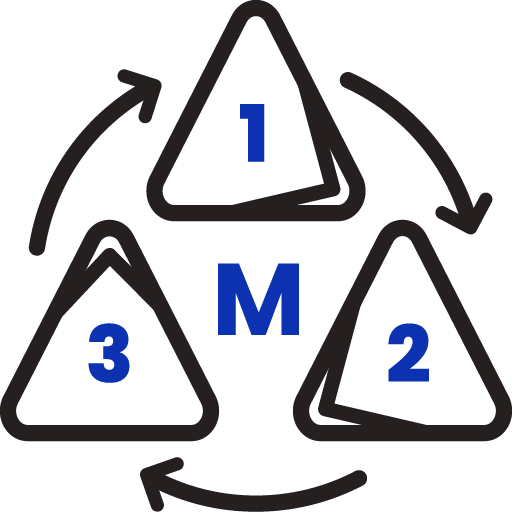







































MEDDICC Value gives every stage of the customer lifecycle its own M, all built around one use case. An M1 positions value: your hypothesis of the value you can deliver, confirmed once a customer has achieved it. An M2 sells value: the M1 personalized to one customer’s situation. An M3 delivers value: the mutual goal you and the customer track once the deal closes.
Ask your marketing lead, your best AE and your head of Customer Success to describe the value of your product, and you’ll get three different answers. None of them is wrong. Each one describes value at a different point in the customer’s journey, and the buyer is left to stitch the value story together.
What is MEDDICC Value?
MEDDICC Value is a value methodology built on the MEDDPICC common language. It breaks the customer lifecycle into three stages (positioning value, selling value, and delivering value) and gives each stage its own M.
Most teams run MEDDPICC for qualification and then bolt on a separate value selling approach with its own vocabulary, which means learning new words for things you already have words for. MEDDICC Value keeps the language you already use. Pain is still Pain, whether you’re qualifying for it, uncovering it in discovery or building a value story around it, and your Champion and Economic Buyer keep their names when you move from qualifying a deal to selling value.
Using the same names also makes your qualification sharper, because you can ask a better question: have you qualified the value to each of those stakeholders?
How do M1s, M2s and M3s fit together?
Every M is built around a single use case. Your company will have several of them, ideally one for every use case your proposition covers, and each one moves through the same three stages. M1s talk about where you’ve done it before, M2s talk about how you’ll do it for this customer, and M3s talk about the mutual goals you’re now working toward together. Each M also has a status: it starts unconfirmed, as a hypothesis or proposal, and becomes confirmed once the customer proves or agrees to it.
What is an M1? The proof point
An M1 is how you position the value of one use case. It starts unconfirmed, as your hypothesis of the value you can deliver. Once a customer has achieved it, it’s confirmed: proof of where you’ve done it before, usually with a number and a timeframe (“Our customers typically see...”).
Behind that line sits the full value story for the use case: the Pain without you, the Gain with you, the Metrics that measure the difference, the Decision Criteria it takes to get there and the stakeholders who care about it. An M1 stays unconfirmed until a customer proves it, and once one does, it carries that customer's name.
M1s aren’t just a marketing asset. AEs use them more than anyone, positioning value with a point of view and proof from other customers, and you can’t get to an M2 without one.
A confirmed M1 in practice: Microlise, a fleet management platform, took forecast accuracy from 25% to 85% in six months, a 60-percentage-point gain. Before, the GTM team had no common language and the board didn’t trust the forecast. After, MEDDPICC ran across the full GTM team and the board backed investment in headcount and international growth. Read the Microlise story.
What is an M2? The personalized case
An M2 is an M1 personalized to one customer’s situation. It evolves from an M1, confirmed or not, combined with what you learn in discovery. It starts from where this customer is today, projects where you’ll take them and translates that into what it’s worth to them each year, using their numbers and their stakeholders.
An M2 still covers a single use case. A full business case usually brings several M2s together.
It sounds like this: "Based on what we've seen with customers like you and the numbers you've shared, we believe this use case will solve your challenge and unlock this much value." The M2 stays unconfirmed until the customer agrees on the value.
What is an M3? The mutual goal
An M3 is the mutual goal you and the customer track after the deal closes: the value promised in the M2, turned into something you measure together. Every M3 has three parts: a measurable goal tied to a specific M2, an owner on the customer's side who's named, and a date that gets reviewed and updated.
This is what Customer Success inherits at handover. Instead of a deck and a summary call, the team gets the goals that were agreed during the evaluation and a clear way to measure them.
Want to write M3s for your own use cases? The MEDDICC Value Program walks you through it.
What’s the difference between a confirmed and unconfirmed M?
Every M starts unconfirmed and becomes confirmed once the customer proves it or agrees to it. That status tells your whole GTM team how much weight a value story can carry.
| Unconfirmed sounds like | Confirmed sounds like | Confirmed when | |
| M1 | “Our hypothesis of value we can deliver...” | “Where we’ve done it before...” | A customer achieves it |
| M2 | “How we propose we’ll do it for you...” | “How we’ll do it for you...” | The customer agrees on the value |
| M3 | “Our proposed mutual goals together...” | “Our mutual goals together...” | The customer agrees it as an active goal |
How do the Metrics change at each stage?
Here's one use case: faster new rep ramp, moving through all three Ms. The numbers are illustrative.
| Stage | When in the deal | Who uses it | Metric level | Sounds like |
| M1: positioning value | Before and early (interest, qualifying) | AEs, Marketing, SDRs | Operational | “Our customers typically cut new rep ramp time by a third, from about nine months to six.” |
| M2: selling value | Mid to late (selling, closing) | AEs, Sales Engineers | Economic, building toward Strategic | “You’re hiring 20 reps in FY28. Getting them productive in six months instead of nine gives each of them three more selling months, which is around $5M in additional bookings.” |
| M3: delivering value | Won to renewal (implementing, delivering, renewing) | Customer Success | The M2’s Metrics, set as a dated target | “Goal: FY28 hires fully ramped in six months. Owner: your VP of Sales, by name. Review: end of Q2.” |
What are Operational, Economic and Strategic Metrics?
The Metrics inside an M don’t stay the same as it moves through the lifecycle. MEDDICC teaches three levels of Metrics, and each one answers a bigger question:
- Operational Metrics answer "How is this value created?" Ramp time going from nine months to six is an Operational Metric.
- Economic Metrics answer "How much is it worth?" Three extra selling months across 20 hires, worth $5M in bookings, is an Economic Metric.
- Strategic Metrics answer "So what does this change?" That $5M taking FY28 new ARR from $20M to $25M and putting the business ahead of its growth plan is a Strategic Metric.
An M1 often sits at the Operational level, because that's what results from other customers can prove. The M2 is where you build toward Economic and Strategic Metrics, because now you have the customer's own numbers to work with.
Value is also stakeholder-specific. A manager will care about the Operational Metric, a VP about the Economic one and the Economic Buyer about the Strategic one, so a strong M2 often carries more than one level. And while the conversation is yours, the Metrics themselves belong to the customer: write them in their voice ("Cutting ramp from nine months to six gives our 20 new hires three more selling months") so your Champion can repeat them in rooms you're not in.
How does an M3 become the next M1? Every win makes the next deal easier
When an M3 is achieved, it feeds back into the start. It either strengthens an existing M1 with a new customer story or, if it's a new use case, creates a new M1 for the rest of the go-to-market (GTM) team to use, whether that's on the website, in SDR messaging or in the first discovery call.
M1s aren't only for new logos, either. You can use them to introduce new use cases to existing customers, which turns expansion into the same research-led conversation that won the first deal.
Who uses M1s, M2s and M3s?
Because every team works from the same Ms, each one knows which version of the story it's holding:
- Marketing and SDRs position value with M1s, in campaigns, on the website and in first-touch messaging.
- AEs use M1s more than anyone, positioning value with a point of view and proof from other customers. Through discovery, they turn the M1s a customer cares about into M2s.
- AEs and Sales Engineers sell value with M2s, through demos, business cases and proposals.
- Customer Success delivers value with M3s, then uses M1s to position new value once the customer is live.
For the full breakdown by team, read Value isn't just a sales thing.
How to build your first M1
Start with one use case. Write its M1, use it in your next few deals and refine it every time you win. The MEDDICC Value Program walks you through building your first M1s, M2s and M3s in about two hours, and it's included in MEDDICC Membership.
FAQs
What is MEDDICC Value?
MEDDICC Value is a value methodology built on the MEDDPICC common language. It breaks the customer lifecycle into three stages (positioning, selling and delivering value) and gives each stage its own M, so marketing, sales and Customer Success work from one value story instead of three.
What are M1s, M2s and M3s?
They are three versions of one value story for a single use case. An M1 positions value: a hypothesis that becomes proof once a customer achieves it. An M2 sells value: the M1 personalized to one customer’s situation. An M3 delivers value: a mutual goal you track with the customer after the deal closes.
What is the difference between an M1 and an M2?
An M1 positions value for a use case, backed by proof from other customers once it’s confirmed. An M2 is that M1 personalized to one customer: it starts from where they are today, projects where you’ll take them and puts a yearly value on it using their numbers and stakeholders. The M1 says where you’ve done it before. The M2 says how you’ll do it for them.
Who owns an M3?
Every M3 has a named owner on the customer’s side, a measurable goal tied to a specific M2 and a date that gets reviewed and updated. Customer Success inherits the M3 at handover, so the team starts with agreed goals instead of a deck and a summary call.
What are Operational, Economic and Strategic Metrics?
Operational Metrics answer “How is this value created?” (ramp time falling from nine months to six). Economic Metrics answer “How much is it worth?” (about $5M in additional bookings). Strategic Metrics answer “So what does this change?” (FY28 new ARR moving from $20M to $25M). Numbers are illustrative.
Is MEDDICC Value included in Membership?
Yes. The MEDDICC Value Program is included in MEDDICC Membership and walks you through building your first M1s, M2s and M3s in about two hours. It isn’t sold standalone. Only the Masterclass can be purchased on its own.