


































- Every GTM team tells the customer a version of your value story.
- When each team uses its own words, the buyer hears a different story at every stage.
- MEDDICC Value gives every GTM team the same value story per use case, built from the MEDDPICC common language, with a different job for each team.
Ask five people across your go-to-market team what your product is worth to a customer, and you’ll hear five versions. Product talks about outcomes, Marketing about benefits, Sales Engineering about features, Customer Success about needs and Sales about Pain. Everyone means roughly the same thing, but your buyer only hears the differences.
This post covers why value selling usually gets stuck in Sales, how each GTM team uses the same value story and how to roll it out for GTM alignment.
Why does value selling get stuck in Sales?
Value gets stuck in Sales because Sales is the team measured on it. Sellers build the business case, own the number and carry the story into every deal, while every other team retells a version of it in their own words. By the time the story reaches the customer from Marketing, CS or a partner, it’s been translated several times.
The result isn’t bad intent; nobody chooses to be siloed. Each team simply learned value in its own language, and nobody gave them a common one.
What is a common value language?
A common value language is one set of terms every GTM team uses to describe what a customer gets from you, from the first campaign to the renewal. In MEDDICC Value, that is the MEDDPICC common language, so Pain, Metrics, Decision Criteria and Champion mean the same thing to Marketing, Sales and Customer Success.
What are M1s, M2s and M3s?
MEDDICC Value is a value methodology built on the MEDDPICC common language. MEDDPICC is a sales methodology for qualifying and winning complex B2B deals, built on eight elements: Metrics, Economic Buyer, Decision Criteria, Decision Process, Paper Process, Implicate the Pain, Champion and Competition.
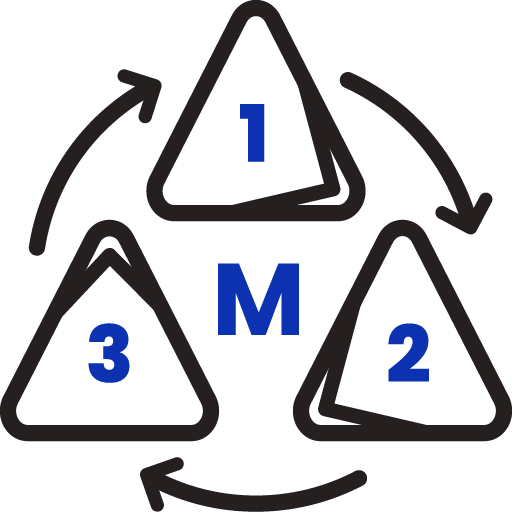
On top of that language sit three Ms:
- An M1 is how you position the value of one use case: your hypothesis of the value you can deliver, confirmed once a customer has achieved it.
- An M2 is an M1 personalized to one customer’s situation, used to sell value. A full business case usually brings several M2s together.
- An M3 is a mutual goal you track with the customer after the deal closes, used to deliver value.
Every team works from the same Ms. What changes is the job each team does with them. For the full explanation, read M1s, M2s and M3s explained.
How does each GTM team use the same value story?
Each team works from the same Ms but does a different job with them. Marketing, SDRs and AEs position value with M1s, AEs and Sales Engineers sell it with M2s, and Customer Success delivers it with M3s. Product builds to solve the Pain customers report in the field, Enablement coaches from M1s and M2s, Channel co-sells with M1s and RevOps works across all three.
| Team | Ms they use most | Their job with them |
| Product | M2, M3 | Build products that solve the Pain customers report in the field |
| Marketing | M1 | Turn confirmed M1s into campaigns, pages and assets |
| Enablement | M1, M2 | Onboard and coach from one library of value stories |
| SDRs | M1 | Open with a message that's credible and relevant |
| AEs | M1, M2 | Position value with M1s, then personalize them into M2s with the buyer's own numbers |
| Sales Engineering | M1, M2 | Demo the use case, not the feature list |
| Customer Success | M3, M1 | Deliver the agreed goals, then introduce the next use case |
| Channel | M1 | Explain the co-sell in one page and one language |
| RevOps | M1, M2, M3 | Track which value stories get used |
Product
Product looks at the Pain customers report in the field and builds products to solve it. The Pain in your M2s shows what customers are struggling with today, and M3s show what they actually achieved, so Product gets field feedback without running a survey. Once Product ships something new, it becomes a new M1 for the rest of the GTM team to position.
Marketing
For Marketing, every campaign, page and asset is an M1 in a different outfit, with the same story, Metrics and stakeholders. Messaging gets built from use cases the field has already confirmed, rather than from a positioning workshop that Sales then has to translate.
Enablement
Enablement can hand a new hire your M1s and cover most of what they need to sell value from their first week. Coaching gets simpler too, because managers and reps are reviewing the same value stories in the same words.
SDRs
An M1 gives SDRs a first message that’s credible and relevant at once: a result you’ve achieved for a company like the prospect’s, with a number and a timeframe. That replaces generic cadences with outreach that sounds like research.
AEs
AEs use M1s more than anyone. They open discovery with a point of view and proof from a company like the buyer’s (an M1), not a list of questions. When that story lands, they personalize it into an M2 using the buyer’s own numbers, and write the Metrics in the customer’s voice so the Champion can repeat them to the Economic Buyer.
Sales Engineering
Sales Engineers build a library of demos around proven M1s instead of a fresh build for every deal. Each demo shows the use case the buyer cares about and ties it straight to their Decision Criteria, so the demo proves the value rather than touring the product.
Customer Success
Customer Success delivers the mutual goals (M3s) agreed at signature: a measurable goal, an owner on the customer’s side and a date. Once a goal is achieved, CS uses M1s to introduce the next use case, so expansion starts from proven results. Read more in Why Customers Who Get Value Still Churn (and How to Stop It).
Channel
Hand a partner a confirmed M1 and you’ve explained the co-sell: who it’s for, what it solves and what it’s worth, on one page and in one language. Partners stop improvising their own version of your value story.
RevOps
When Ms are tracked in your CRM, RevOps can finally answer questions every revenue leader asks. Which M1s get pulled into opportunities most often? Which convert to M2s, which M2s become M3s, and how fast do M3s get achieved? That turns value from a messaging exercise into something you can measure at every stage.
How we do it at MEDDICC
We use M1s in our own marketing, most visibly in the customer stories on our website. Each story is built around one use case and leads with the result, which is what makes it an M1. Microlise, for example, improved forecast accuracy from 25% to 85% in six months by using MEDDPICC as a common language across its GTM team. Its CRO, Mike Blackburn, put it this way: “I believe our numbers now because we’re using MEDDPICC to validate.”
A PE-backed B2B org doubled its win rate in another story. Our sellers can lift either confirmed M1 into a first message to a prospect who looks like that customer, and when the prospect shares their own numbers, it becomes the start of an M2.
What changes when every team uses the same value story?
When every team uses the same value story, the buyer hears one consistent case from first touch to renewal. Handovers carry the promises that won the deal, new hires start from a shared library of value stories rather than tribal knowledge, and every achieved goal becomes proof the next team can use.
It also changes how teams work with each other. Marketing can see which messages land, because the field confirms them in live deals. Sales stops rebuilding the business case from scratch, because confirmed M1s already exist. And Customer Success stops inheriting accounts with no record of what was promised.
At Microlise, four customers are now live with a Proof of Value, each contractually backed by an M3, and Customer Success validates M3 delivery as part of a standardized customer journey.
How do you roll out a value story for GTM alignment?
Start small and let the story prove itself in live deals before you scale it. Most teams follow four steps:
- Pick one use case. Choose the one you sell most often, or the one with the strongest customer results.
- Build its M1 together. Get Product, Marketing, Sales and CS in the same conversation, so the M1 uses everyone's input and everyone's buy-in.
- Use it in live deals. Personalize it into M2s for real buyers and mutual goals (M3s) for the ones who sign.
- Refine it as you win. Each achieved M3 strengthens the M1 or creates a new one, and the next team starts from there.
The MEDDICC Value Program gives your whole GTM team one value story to work from, and it’s included in MEDDICC Membership.
FAQs
What is value selling?
Value selling is a way of selling that connects what you sell to the outcomes a buyer cares about, so the conversation is about their business rather than your product. It works best when the whole GTM team, not only Sales, tells the same value story. Value selling frameworks compared covers the four common approaches.
Is value selling only for sales teams?
No. Selling is one stage of value, but Marketing positions it before the first call and Customer Success delivers it after signature. If those teams use different words for it, the customer hears three different stories. A value methodology works best when every GTM team uses the same one.
Do non-sales teams need to learn MEDDPICC?
They need the parts that describe value: Pain, Metrics, Decision Criteria and the stakeholders who care, including the Champion and Economic Buyer. Those terms are simple to learn, and using them means nothing gets lost in translation between teams.
Which team should own the value story?
No single team owns it; each one owns a stage. Marketing owns how value is positioned, Sales owns how it's sold and Customer Success owns how it's delivered. A RevOps or Enablement leader often coordinates the library so it stays current.
How long does it take to roll out across a GTM team?
The MEDDICC Value Program takes about two hours per person. Most teams then build their first M1s for one use case and refine them in live deals, rather than trying to cover every use case at once.