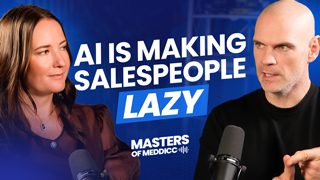
00:00 Jeff Miller: I think a great salesperson will build a relationship and help attach to that person's career. So I think building the relationship with your economic buyer — and then differentiating between the decision maker and the buyer — and helping those people get to the next stage of where they're at: you've mutually agreed to what success looks like with the customer, you understand what their outcomes are, their before scenario, their after scenario, what this means. Why is this project so critical ? Really defining out the compelling event. But it's not just the compelling event piece — it's more about working with that champion and then becoming a lifelong friend and buyer. 00:52 Andy Whyte: Hello and welcome back to another episode of Masters of MEDDICC. I'm here with Jeff Miller. Welcome, Jeff. Why don't you introduce yourself and let us know how you got into this wonderful world of sales ? 00:52 Jeff Miller: Hey, Andy. Thank you for having me. The name is Jeff Miller — happy to be on. I got into sales a little over 30 years ago when I graduated college. I knew that the real opportunity to make money was taking advantage of the assets you had. And for me, that was an outgoing personality and being good with people. I looked at consulting opportunities, some computer science, the engineering and programming side of things — but I just did not enjoy that enough. I knew that dealing and working with people, and helping people achieve their goals, was something I always wanted to do. So I went into sales. And the first job I did taught me invaluable lessons about rejection — which many of us face throughout our entire careers. I was a door-to-door salesman selling long distance. I was literally handed a zip code and a map of all the office parks, and I would go door to door. 02:06 Andy Whyte: What were you selling ? 02:06 Jeff Miller: At the time, it was for a company called LDS, which was then merged with LDS Metro Media, which was then merged with MCI — and then a lot of consolidation, and a lot of bad things happened in telecommunications. But in essence, I would literally go to a media office and say: "Hey Andy, let me see your phone bill — I think I can save you some money. " We're talking like tenths of a cent. Getting a $1,000-a-month customer was like bagging an elephant back in the day. But you could make a lot of money doing it. And you're showing up every day, going door to door through office parks, trying not to get thrown out of buildings, watching the signs that say "no soliciting. " I have a special spot in my heart for that kind of hustle — and I can't tell you how many times I'd see people dragging copy machines and big things they had to sell door to door. I think there's a lot of mutual respect and a lot of grateful smiles that I wasn't selling copiers. 02:48 Andy Whyte: Yeah. I have this theory around that type of sales — you learn so much because you're doing lots of micro sales cycles, but you get the full cycle every time. And I have this theory that so much of sales is pattern recognition. You get to a situation that's a rejection, and you've been in that situation ten times before. The more you meet that moment, the more experience you get at overcoming it — or finding out what happens if you take the wrong path. So I have a real love for that type of sales and for people who come from it, because you get an accelerated learning experience over the full cycle. How many times do you get to ask for the order ? Instead of once a week like a typical AE does, you're asking five times a day. And I don't know about you, but I had a real challenge going from that type of sales into what we'd class as more professional enterprise sales. How did you make that jump ? 04:09 Jeff Miller: Yeah, great question. One of the things you learn most in door-to-door is that you're very, very transactional. You've got to think on your feet constantly. And most of the time, objective number one is getting past the first gatekeeper — which you have to do in top-down enterprise selling anyway. But in door-to-door you're learning the hard way. You've got to come with something of value to get to the next step, or you get immediately blocked and you're onto the next office. The valuable lessons there are about situational awareness. A lot of these people — secretaries, office managers — they have bad days too. Coming in too hot, too cheesy, or with no value is really difficult. It was a real education. I'd just graduated from Clemson University and started literally two weeks after graduation — very green. I didn't know anything except that I'd done a lot of door-to-door as a kid. 05:42 Jeff Miller: I sold water purifiers growing up. My parents — best thing they taught me was: if you're going to play sports, you have to fund your travel. So we'd go door to door selling candy bars and I always did exceptionally well. My parents made my daughters do the same when they were selling things for cheerleading and school activities. Nowadays you just post on Facebook or send an email — I made them go door to door because that's what I grew up with. But you miss out on that human-to-human interaction. And if you're going to get good at sales, you have to be able to read people, understand situational awareness, and come with enough charisma or value to get them to the next stage. 06:33 Jeff Miller: So I did that for a year and then transitioned into the software world. And the hardest lesson I had was: how do I slow down on asking for the sale and really make sure I'm driving the right process ? Back in those days there was no MEDDIC. Most people had their own version of a sales process. The first meeting I ever went on — I was selling ERP software — I tried to close it on the day, because that's what you did in door-to-door. I went through my pitch, felt great about it, and essentially said: "Can you email me the contract ? " And she said: "What do you mean ? " I was like: "I've closed it. We're done. " She said: "No, no — you need to come back to the office. We have to create a proposal, send it to finance. If you want to go ahead, come back. "07:30 Jeff Miller: I remember thinking: that sounds bonkers. Absolutely bonkers. Long story short, it took a few more weeks. And this was before DocuSign had really taken off. So I drove back — quite a long way. I wasn't yet an AE, so they didn't have a company car, I had to rent one each time. I arrive about 45 minutes early, sitting in the car waiting for my meeting, and I see him come out of the building putting stuff in his car. And I think: oh no, he's going home. So I get out and go to him, and he says: "Oh yeah, I forgot. " And we actually signed the contract on the spoiler of his car. Nothing. This is three or four weeks later than I could have done it on day one. And that made me laugh when you said it was the shortest sales cycle you'd heard. It was definitely not the optimal one. I still don't know what I was doing selling ERP. But I just remember there were a few cool things the software did that resonated with me, and he must have had sympathy or something. 08:54 Jeff Miller: I learned a long time ago from a mentor of mine that the number one asset every seller has is time. And it's not about where to spend time — it's really about focusing on where not to spend time. You've got to eliminate waste by asking all the right qualifying questions ahead of time. I took Hortonworks from scratch to a quarter of a billion in revenue as a publicly traded company. And you don't get there unless you can implement process at scale, understand ICPs, and figure out how to shrink and condense a sales cycle to get rep efficiency. All the things VCs measure obsessively — you have to get really, really good at those in the most demanding of environments. Because you're public: if you don't hit a number, the stock drops, technical founders don't understand it. 09:44 Jeff Miller: They don't understand go-to-market. They understand how to build great technology. And some technical founders don't have an appreciation for what we do because they think the product just sells itself. And when you tell them their baby is ugly, it's very hard for them to hear. And that's where open source allows you to constantly innovate and take customer feedback. If you're not listening to your customers — if customers aren't first in your mentality — your product is most likely going to fail. 10:13 Andy Whyte: Yeah, for sure. And going back to what you said about the product-led growth motion — and having that experience of a user engaging with your product before any sales conversation — I think that's one of the places where MEDDIC is really powerful in a way that goes beyond what most people see. The way we see MEDDIC is a little bit different from the broader market. We see it first as a common language. Most people still keep MEDDIC in the qualification framework box — which of course it's world class at. But what we see is this common language, and what that enables: if you take that mindset, MEDDIC can be anything. It can be a methodology, a qualification framework, a way to measure the impact of a product or the strength of a region — because all of a sudden you can see where you're strong in certain elements and where you're not. 11:07 Andy Whyte: But one of my favourite ways it helps is as a go-to-market common language. Because now you have a language that transfers across from marketing to channel to SEs — for talking about anything relating to value, stakeholders, and process. We've got the words. And so if you're an organisation with a product-led growth motion or an open source motion — to a degree you're almost behind a one-way mirror. You know they're there, but they don't know you're there yet. They're kind of finding their way around. And what you want to do is signpost them — this is the value we can bring, this is how we can help. And the way to do that is by making sure you really resonate with the pain your solution is solving. Because so often our customers don't actually know about the full breadth of the pain they're facing. There's quite often a situation where they think they already know it, or they don't know it can be solved. So having that marketing motion that can inform — "if you're this type of customer using our solution, did you know we can help you solve this ? And did you know these organisations have seen this value from solving it ? And here's how we do it" — which is the really important part, and which is the decision criteria. 12:28 Andy Whyte: We very boldly believe that the majority of customers have a really, really poor idea of what the decision criteria should look like for anything — because they're not experts in buying it. They're experts in whatever their day job is. So we think if you inject MEDDIC into motions like product-led growth and open source, it gives you the framework to say: let's make sure this customer truly understands how we solve this. Let's make sure they truly understand the value. Let's make sure they truly understand the differentiators — this is how we do it, this is why we're the only show in town for this. That's the marketing angle, the value angle covered. And then you've got the stakeholders, where the sales team can engage. Because you can say: OK, that person using the product is just a developer or an engineer — they're not the person you're going to sell to. But knowing they're using the solution the way they are, we know we can go and find the champion persona profile. So the sales team can use the PLG data to understand who's using what and where, and then go find the right stakeholders. 13:33 Andy Whyte: And of course, the process starts for us not when a formal evaluation begins — the process starts the second the customer engages. And you can use MEDDIC in the decision process to take them from — the decision process isn't just "should we buy this ? " It starts with: should we even look at this ? Should we even open this website ? Should we even open this email ? Taking them all the way through from there. So yes, I do think it's a go-to-market motion — and there's just that baton being passed from the marketing motion to the sales motion. And the more you use that common language, the more effective it becomes. 13:33 Jeff Miller: Yeah. I couldn't agree more. It's a common language that you can carry consistently across the organisation — and that consistency is so, so important. It's Command of the Message. The marketing person delivering exactly what the salesperson is going to say. And also the product managers saying the same thing. So many times in companies, getting from zero to $10 million you can do relatively easily if you understand startup sales motion. Going from $10 million to $25 million is harder. $25 million to $50 million is brutal. $50 million to $100 million — very brutal. $100 million-plus is a totally different kind of brutal. But if you have the right alignment across everybody — everybody can articulate the value prop, everybody knows where you win together, everybody's consistent — it helps with educating the market and driving the awareness that gets you through those inflection points. Because as you innovate, you want to make sure every release is educated to the market, that you've got the right enablement and the right steps in place. And that's the same thing with going through every stage of MEDDIC. I don't know how you close deals unless you document every one of those steps. You can still close deals by luck — right place, right time — but if you're trying to manufacture compelling events, which is one of the hardest things in software: how do you get clear, mutually agreed-upon metrics that are measurable ? How do you benchmark fairly against those things ? [QA: check word count — approx 252 words]16:10 Jeff Miller: If you don't document across the entire process, you leave yourself exposed. 16:10 Andy Whyte: Yeah, I agree. And the challenge is that it's not just hard to get those metrics — there are typically two reasons why. First, the customer doesn't know their side of the metrics — you can't apply the uplift you know your solution can bring. Or second, they don't want to share it with you. And so it comes back to what we call the discovery paradox. Sales teams have been told they need to go in and do discovery, and the way they've been told to do it — by LinkedIn gurus who've given them ten silver-bullet questions that apparently unlock everything — we know doesn't work. Because customers don't like being interrogated. That's what it feels like. And you're left in this paradox where the customer wants to know about the solution, but your solution is broad — just pitching doesn't do anybody any favours. You've got to do discovery. We think there's a better way. And it actually comes back to what you said about Metrics. It's about using what we'd call an M1 — the success stories you've had from your existing customers. I like going into a first meeting with whatever the company profile is — size, location, industry — looking at my existing customer base, finding the relevant success stories, and telling the story of: "I've seen this before, and here's how we helped. " Because it means I don't have to ask the customer what keeps them awake at night and who else cares about it — all that nonsense. Instead, I can go in and show I'm prepared, I'm relevant. I'm doing all of this while storytelling and reference selling, and I'm talking to the customer about problems they may not even have known they had, or didn't know could be solved — and crucially, how we solve them. [QA: check word count — approx 306 words]18:18 Andy Whyte: And what we find from that approach is: those customers who wouldn't normally volunteer their own metrics — because you've framed it with "Company X, who we think is like you, was losing 20% of X from this pain" — they'll say: "Actually, yeah, we're probably about the same. " Or: "Oh, we weren't quite that bad. " Or: "No, we're actually much worse. " Because you've given them just enough context to anchor themselves and benchmark. It's like giving them a frame of reference. The credibility that comes from walking in prepared, from showing you've done it before — it's just such a game changer. So we really do a lot with Metrics to try and broaden out how it gets used, and therefore to have more success with it. 18:18 Jeff Miller: I think a great salesperson will build a relationship and help attach to that person's career. Building the relationship with your economic buyer, differentiating between the decision maker and the buyer, and helping those people get to the next stage of where they're at — that's where I get the most joy. Not from figuring out raw calculations, server-side success criteria, and fair benchmarking — though that's all important. The real joy comes when you've mutually agreed what success looks like with the customer, you understand their before scenario and their after scenario, why this project is so critical. But it's not just the compelling event — it's working with that champion and becoming a lifelong advocate and friend. I cannot tell you how many customers I've worked with across 20-plus years of open source. If you carry yourself with tremendous integrity and always put the customer first — not your own commission or your own quota — you're going to have a very good outcome. The most joy I've had is building that champion and watching them deploy your solution, be successful, and then go from being a developer one day — because they downloaded the product — to a Director, to a VP, to eventually a CIO who picks up your call every time on their cell phone because you've done work together through multiple companies. I have buyers I've worked with across four or five different companies. And I think it's a testament to truly caring about how to make them successful. [QA: check word count — approx 255 words]21:07 Jeff Miller: So it does tie everything back to MEDDIC. Everyone is equally important, but building that champion and having them for life — that's where I get the most joy. 21:07 Andy Whyte: Yeah, I love that. I went to the wedding of a champion of mine last year, who's now one of my close friends. The funny thing — and we laugh about this now — is that at the time he was Head of eCommerce at one of the fastest-growing companies in the world. He was probably one of the most in-demand people by headhunters at that point, because the company was growing so fast. And this was when marketing technology was really taking off. I'd spent years just trying to get a meeting with him, and now he's one of my best friends. It's funny how things come full circle. 22:13 Jeff Miller: One cool example along those lines — I sold to a customer over multiple companies, did a very large transaction, built a tremendous relationship over the years, and actually brought that person in to be a Field CTO for us. Seeing them blossom and be super successful in that different capacity was really rewarding. And staying close — they won't stay a Field CTO forever, they'll go back to running engineering at a company. But getting them into that role was really cool, because they got to see the "dark side" — what we go through as sales and go-to-market people — and they learned how to communicate across both worlds. And you learn so much from how they think and process things. If you're a Type-A, meat-eating salesperson, you sometimes forget about certain things — and you can learn a lot from how technical people process differently. 22:52 Jeff Miller: I read a book a while ago — for those who have ADHD, it's a great one called Faster Than Normal. I have ADHD, and I was trying to explain to my wife why, every year for Lent I'll give up sweets, and every year she gives me a huge Easter basket — and I don't just eat one sweet, I eat the entire basket in one sitting. Boxes of Cadbury eggs, boxes of peanut butter eggs, jelly beans. It's because our brains don't understand the concept of moderation. They're wired very differently. You have to give yourself those dopamine hits to keep you at the level you need so you can focus really well. So I read that book to explain to my wife: this is how my brain works. Please understand that when you see me going to work out three times a day or doing something a normal person wouldn't consider — this is just how I'm wired. And I think when you understand your customers and how they think — and you marry your thinking to theirs, because ultimately it doesn't matter what you want to achieve, it's how do you make them successful — that's when you truly mature as a seller. You look at the full picture, and you realise all pieces of the MEDDIC process have to be working together to get your customer through yours. 24:45 Andy Whyte: Yeah. And I'm going to ask you something — I have a theory that people with ADHD have a bit of a superpower for sales. Obviously there are well-documented downsides, but the way I describe it: when a customer is talking to you in a sales conversation, and you're curious and engaged, a typical linear brain just follows the path — camera-steady, following a linear sequence of questions. But an ADHD brain goes: "Oh, what about this ? Or that's like this, or have you thought about that ? " And all of a sudden you've got these four expanding threads on the conversation, and you're thinking: "What that customer just described is exactly like this use case I had. " That makes the conversation so much richer for the customer. You're digging deeper and surfacing a more value-oriented conversation. They're going to learn more from you because of all those connections you're making, rather than just following a linear path. 24:45 Jeff Miller: Yeah, no, I totally agree. You have to learn how to manage it, of course — and not everyone does. But once you do, it absolutely is a superpower. People who conquer dyslexia and ADHD are some of the most successful people on the planet — so many high achievers have it, because they figured out how to harness it and do the work of two or three people because of it. 26:34 Andy Whyte: Super interesting. OK — one last question for you. What do you think is the most important element of MEDDIC ? The one where, if you're reviewing a deal and it's not there, you go: this is game over. 26:34 Jeff Miller: Yeah. You know, it really ties to the question: what are you trying to accomplish ? If it's getting a deal done on a specific timeframe, then for me it's really understanding the Decision Process — and the Paper Process alongside it — to make sure it can actually get done. So many times, especially in open source — where the technology is already being used, so you often have the technical win — if you can't tie that to a process that ultimately gets the deal through, it's very difficult. Selling to banks — they have compliance, they have security. If you're selling a cloud product, it may take nine months to get through their security review process. You have to build time in for all of that and educate the organisation. And a lot of the time, the buyer is maybe a developer who's just been promoted to Director for the first time — it's their first time going through an entire buying process. I can't tell you how many times I've been going through closed plan reviews with reps, and when you dig into that closed plan, you realise: has this person ever successfully purchased software before ? Do they know the process ? How many times do reps miss that little step ? 28:29 Jeff Miller: So I think — all things being equal, whether they're doing PLG or open source and they're already familiar with the product — the most important thing at that stage is really understanding the process to close, and making sure it's tested at every gate. I'm a big believer that you have to get your customers to commit to a mutual, reverse timeline and sequence of events that you document. Because then when your CEO asks why a deal slipped, you've got everything documented. "This is exactly what they agreed to. You can see it right here. " As long as you document your process, you should be in a good position. So I'd say that's probably the most important in my experience, based on what we sell. 28:29 Andy Whyte: Yeah, I like that. And I also think that at your level of seniority, the Decision Process becomes more front-and-centre because the majority of opportunities you're reviewing are more mature by the time they reach your desk — whereas some of the other elements matter more earlier in the process. I think that's a great way of answering the question. I love how you said "depends on the circumstances" — that's actually a brilliant way to answer it, and it just shows the versatility and universality of MEDDIC. Which is really cool. So yeah — thank you so much, Jeff. This has been an incredible conversation. Thank you so much for your time. If people want to connect with you, or if you have open roles — where should they find you ? 29:52 Jeff Miller: Yeah, just hit me up on LinkedIn — I'm very, very active on there and happy to talk to and help anybody. When I went on my journey, if I hadn't met the mentors I had in my career, it would have been very tough. There's a lot of information out there now — I just wish everybody could get a decoder ring to tell them which bits are actually worth their time, because everybody's in a different position. I'm a serial startup person, so if people have questions or concerns, just hit me up on LinkedIn. I'll definitely reply and help any way I can. 29:52 Andy Whyte: Thank you so much, Jeff. 29:52 Jeff Miller: Thanks for having me — great talk.
































.png?width=273&height=327&name=image%201%20(1).png)