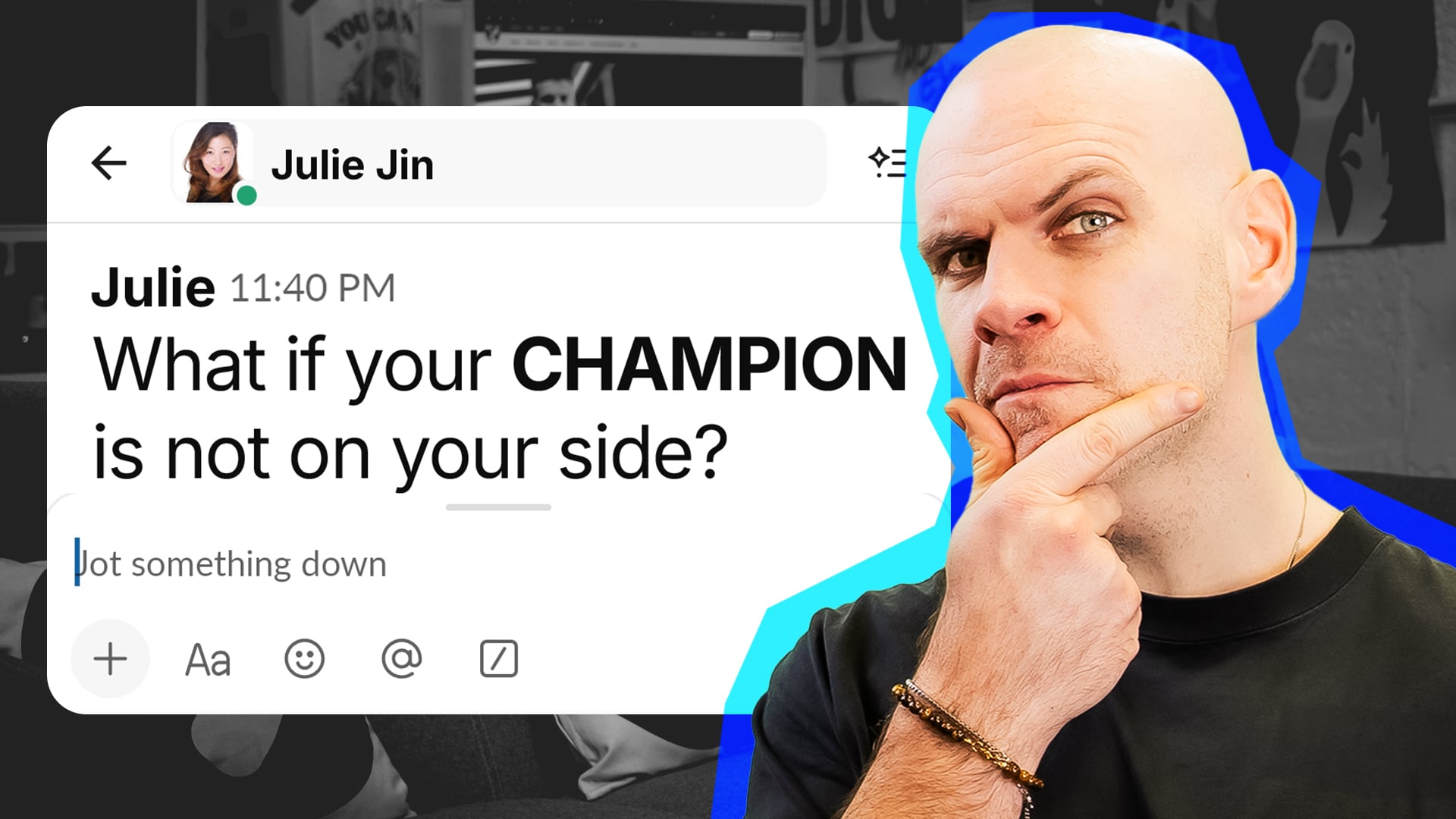
00:00 Pim Roelofsen: Welcome to The MedMen Show. My name is Pim and that's Andy. 00:03 Andy Whyte: What are we talking about today, Pim? 00:04 Pim Roelofsen: Today, Andy — we are talking about the crucial champion trait that typically gets overlooked. So let's refresh on the three traits of a champion. They have to have power and influence. They have to have a vested interest in your success. And they have to be selling internally for you. So which one of these three do we think gets overlooked the most? 00:26 Andy Whyte: For me it's very obvious. It is the middle one — vested interest. How they win when you do. 00:33 Pim Roelofsen: Yes, indeed. And as we know, this can be both personal and business-related. In an ideal world, those two worlds collide — where the individual champion sees their own success tied directly into the company being successful as well. That reminds me of someone being new to a business, wanting to make a big impact, and being able to do that with whatever you're bringing as your solution. My friend Frank landed a new role at a very cool company and then just wanted to implement MEDDIC there. And pulling everything we could do together with them was directly tied to his vested interest of making a big impact within his first three or four months with that team. 01:28 Andy Whyte: Yeah. And we saw the same with another great champion of ours — George Campbell. Not a one-time champion, not a two-time champion — a three-time champion. We're actually taking him for lunch tomorrow, and we've got a surprise for him. Look out for that on the channel. But that's an example where his vested interest is not necessarily MEDDIC success itself, because he's had that a couple of times already. His vested interest is that he's very driven, very successful in his career as an enablement professional — and he wants to deploy his playbook. But he can't execute that playbook without his common language, which is of course MEDDIC. So his vested interest in working with us is that he wants to uplevel the organization he's just joined, and he needs the common language to do it. 02:14 Andy Whyte: And I know you have a really interesting comparison of two different champions working for the same type of solution — and they couldn't be more different. Can you tell us a bit more about that? 02:26 Pim Roelofsen: Yeah — that's one of those scenarios that teaches you so much in sales. If we hadn't been through it, we wouldn't have learned those things. And this for me was where I really understood the difference between personal vested interest and business-oriented vested interest. I was selling the same solution to two people in the same role — but at two very different companies. One was a startup, and one was probably one of, if not the oldest department store in the world. 02:54 Pim Roelofsen: The startup champion's vested interest was their own brand and reputation. So what we were trying to connect them to was that we had podcasts and live events they could speak at — we could really elevate their career that way. That was their vested interest in working with us. Whereas the champion at the department store just cared about the department store. They had worked there for 30 years — no word of a lie. And that department store has a very strong association with the color yellow. I always used to joke that if you cut them in half, they'd be yellow — they were so in tune with their company. All their vested interest was success for that department store. If I had said to them "become a customer ambassador, we'll put you on stage, we'll get you on our podcast" — they would have run a mile. Whereas with the other champion, that was exactly what they wanted. 03:54 Pim Roelofsen: And so it's really about the salesperson truly finding that person's vested interest. We talk about power and influence as being very, very important — and it is a deal-breaker. If they haven't got it, they can't be a champion. But no one is going to be able to effectively sell internally for you unless they have a vested interest — because why would they? If they have the vested interest, then they will be empowered to sell internally for you. Power and influence is almost binary — you either have it or you don't. But vested interest is something you have to put the work in to find. You have to get close to that person and really understand what's driving them towards wanting to work with you. 04:32 Andy Whyte: Yeah — spot on. Those two traits: the ability to sell on your behalf is something you can build. But the vested interest is something you have to truly connect to. If you don't understand how your champion wins when you do, you've got work to do. 04:48 Pim Roelofsen: Now — to take us home on this. I was your champion once. 04:52 Andy Whyte: Yeah. 04:53 Pim Roelofsen: Arguably, I bled green at the time — that was our brand color. You weren't an alien, just to be clear. And nowadays it would probably be blue, given the brand change. But the point is — and I digress — career progression and visibility with senior leadership was very much my vested interest at the time. And winning bigger and faster with my own team. And ultimately it didn't just lead to career progression — it put me here on this couch. 05:22 Andy Whyte: Well — I would say that was pretty big career progression! 05:28 Pim Roelofsen: But yeah — that for me is one of the key messages I want to leave this episode with. We often see salespeople looking for their champion — the champion. And of course it depends on the solution you're selling and the size of organization. But if you're selling to larger organizations with a broad solution that offers broad value and lots of use cases — get further into the organization. If you can find that person who sees the value your solution can bring as a win for them, they may not be your main contact — they may be a secondary champion. But finding those people will, if nothing else, give you key insights into where you're winning, where you're losing, and just help you make progress. 06:16 Andy Whyte: And there's nothing more powerful than a person with that vested interest. My favorite — and we actually had this on a call yesterday — my favorite vested interest is when somebody is in an interim role. They're motivated, and if you can tie some of their success to your solution, that is the cherry on top. 06:36 Pim Roelofsen: Absolutely. So in summary: do they have power and influence — and how does that show? Have you built them up to effectively sell on your behalf? And how do they win when you do? If you don't know — there's work to do. Go figure it out. A very effective way I've seen is simply storytelling about how another champion won when they worked with you before — and then asking: "Is this similar to how you see things? Would this kind of scenario work for you?" The worst that can happen is they say no — and when they start correcting you, that gets you even closer to understanding their vested interest. 07:12 Andy Whyte: Beautiful. Cheers to that! 07:13 Pim Roelofsen: Cheers, Andy!









































.png?width=273&height=327&name=image%201%20(1).png)