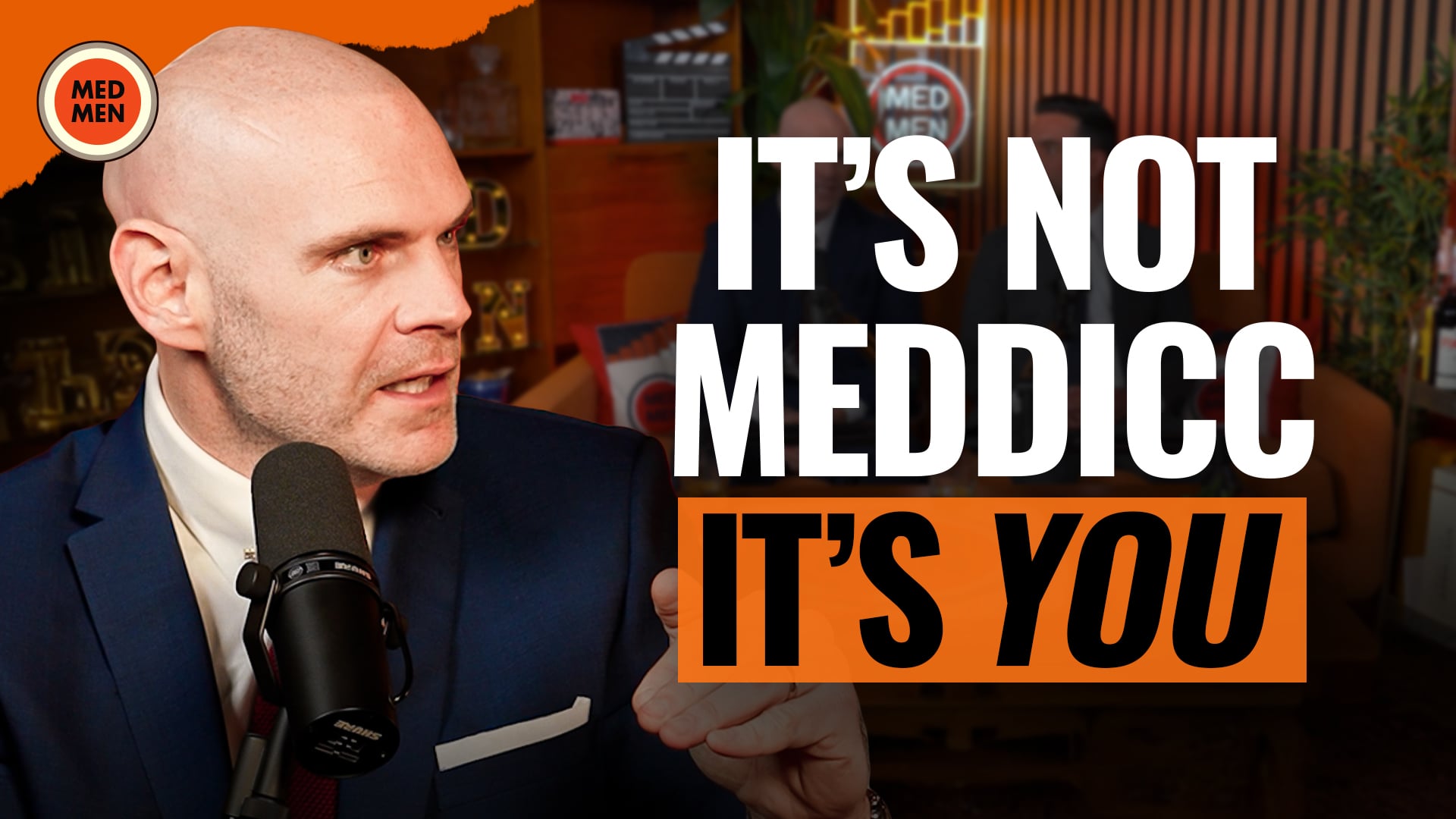
00:00 Andy Whyte: Every SaaS company has a dirty secret. It's not their product that is their moat — it's the switching costs from the product itself. And AI is draining everybody's moat. If you are an organization and you do not have a value framework that takes the value you deliver to your customers from positioning to selling to delivering, then your moat is at risk of being drained — and churn is right around the corner. 00:30 Pim Roelofsen: Well, Andy — how's that for a dramatic opening to an episode? 00:34 Andy Whyte: It's true. 00:35 Pim Roelofsen: Yeah, it's very, very true. And I think we see this a lot more now. The stock markets are kind of indicating that SaaS is in a little bit of trouble. There are a lot of question marks. But I think people are misdiagnosing what's happening. I think people are saying that software is becoming less valuable. But I think the barrier to changing software is becoming less valuable — and therefore where people are locked in, the moat they thought was because of the product was actually just the cost to change. Now changing is easier. 01:08 Andy Whyte: Yeah. And there's a bit of a conflict there in terms of the growth plans that most organizations have. I was reading a report earlier today — 58% of growth having to come from existing customers, cross-sells and upsells, platform rather than just one product. And this trend you're talking about is basically eating away at that. 01:28 Pim Roelofsen: Yeah. And Customer Success teams have an incredibly tough job. Because you can have a CSM who is brilliant commercially, knows the product inside out, is great with customers — but so often if they are not set up for success, if the deal is closed and there's been no true success criteria established — the business case over here and what they're having to deliver is over there, completely separate, no continuity, no pathway to connect those two worlds together, no value delivery framework — then straight away the Customer Success person is on the back foot. They're having to pick up challenges that are always going to be there, while the stakeholders start to distance themselves. "OK, you sold it — now deal with my team." You get delegated down. 02:19 Andy Whyte: And both sides are in the dark, aren't they. 02:21 Pim Roelofsen: They are. So this is why it's absolutely critical that you have a value framework that carries through from positioning to selling to delivering — all the way through. OK. So on one side we are in the dark — no clue what we're aiming for, who's going to be involved, or how we get there. But with this framework, yes — there's another scenario possible. 02:48 Andy Whyte: What does it look like? It looks like a utopia state, Pim. We call it MEDDIC Value. It's how we've evolved MEDDIC to be more than just qualification, more than just for the sales team. We think about MEDDIC as being this common language for the whole go-to-market team across the whole customer lifecycle. And so what that means in this context is that before Customer Success gets involved, there would have been a scenario where the sales team would have positioned value in a particular way and personalized that value to the customer — so much so that when the deal was closed, the customer would have a proposal in front of them that said: these are the use cases we're looking to deliver, here's the value we're promising from these use cases — and both parties would be bought into that. 03:36 Andy Whyte: So now the deal has been closed. Those use cases — we call them M1s and M2s through the lifecycle — then become M3s, because they're now for the customer to have delivered. And so it becomes the Customer Success and post-sales team's job to deliver the value promised within those use cases, within those M-phases. The beauty of this is: once they're delivered, they become M1s that can be used for the rest of the go-to-market team. We now have a success story. But the work with the customer doesn't stop there — because you either set the bar higher (if we aimed for 20% efficiency, let's go for 25% now we've achieved it), or there might be new use cases you can now unlock and solve more pain with. 04:13 Andy Whyte: And so the idea here is: when we're having those renewal conversations, having those conversations about the value we've delivered — it's not "oh, we answered 25 support tickets, we were really quick, delivered on time." It's: "When we engaged with you to solve this pain and help you achieve these goals, we promised you this much value. Here's when we achieved it. But we didn't stop there — we unlocked more value. And it's right there in front of you because it's been the KPIs, the goals, everything that this customer relationship set out to be." Simple as that. 04:51 Pim Roelofsen: Yeah. And when you have it as a common language, you can start taking a use case from one customer that worked there into another account — and the whole team can do the same thing. And what I liked about everything you just said is that it lifts across the full customer lifecycle. Many companies need to see their growth coming from this stage of the customer lifecycle. But equally, the cohesive customer journey spans across the full go-to-market team. It ties everything together, doesn't it? 05:24 Andy Whyte: It does. OK — time to get into some questions. 05:28 Pim Roelofsen: Question time! 05:32 Andy Whyte: Let's see them. I feel like I need to limber up for this. 05:37 Pim Roelofsen: All right — get ready. Here they are. First question: people always say MEDDIC is for sales, but you're talking about Customer Success. How does that work? 05:46 Andy Whyte: I think I did kind of just answer that. But effectively — we see MEDDIC as a common language that speaks to three pillars of customer engagement, and that can be prospective or existing customers. The first pillar is value: the pain you solve for the customer, the value the customer gets from solving that pain, the delta between those two states — which is the metrics — and how we deliver that value, which is the decision criteria. The second pillar is stakeholders: who's our champion, who are our coaches, who are just contacts, who's the economic buyer, who's the competition internal and external. And the third pillar is process: the buying process, how we're going to sell, how we're going to merge these two worlds together — because they're both important. Anyone who says there's no selling process is basically admitting they're order-takers. Those three pillars overlap: the more value you build, the more urgency there'll be, the faster the process will move. But you need to make sure you're engaged with the right stakeholders. And all of that is just as important for existing customers as it is for prospective ones. 06:57 Pim Roelofsen: 100%. The one I typically see as being under-indexed is the process one — and that's where deals slip. And deals that slip have an incredibly increased chance of ultimately going lost. OK — we've got more questions. Let's get into this next one: can AI tackle complex solutions? 07:12 Andy Whyte: So today there is not an AI agent that's going to move your ERP system from SAP to Workday. But this time a year ago, there was no such thing as AI agents in most people's minds. So in a year, we've gone from almost no one understanding the concept of an AI agent — to today, the majority of people in our industry understanding that concept and being able to see how an AI agent would help with a migration process. Here is a deal signed today — it will be renewed potentially in a year's time if it's a one-year contract. Where is AI going to be in a year? Who's to say that in a year's time, the things I just described — Oracle to Workday, Workday to SAP — can't be simplified? 08:06 Andy Whyte: If I was starting a business today, I'd be thinking about how I can create AI agents that help to migrate from one system to another. I'd embed myself right into the SAP ecosystem, or the Workday ecosystem, or all of them — and have a product that says: "I can help you reduce your switching cost from nine months to implement a new ERP system to weeks." 08:29 Pim Roelofsen: Yeah — it does go fast. I was switching from one large language model to another recently. It took me five minutes and all my data was still there. I think we'll see the same shift in the industry. 08:40 Andy Whyte: Lights back up. OK — to summarize: switching costs are coming down. AI is making it much easier for organizations to evaluate and switch to new solutions. But it's not the end of the world. If you can clearly articulate to your customers what value they're getting from your solution, you'll be safe. The problem is when you don't have a way of illustrating and positioning the value you are delivering. We can help with this — this is what we do. So get in touch if you're looking for something that goes way beyond just what the sales team delivers for value. We're talking about the whole customer lifecycle, for the whole go-to-market team. And to that — Pim, I will drink. 09:24 Pim Roelofsen: I will drink to that too. I do have one more thing to say though. 09:27 Andy Whyte: Yes? 09:29 Pim Roelofsen: To clearly articulate what we're seeing with these videos — only 10% of the people watching them are actually subscribed to our channel. So if you want to do us a small favor, like and subscribe via the button here, and we'll see you next time!

































.png?width=273&height=327&name=image%201%20(1).png)