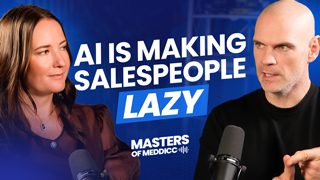
00:25 Pim Roelofsen: Welcome to The MedMen Show. My name is Pim and that's Andy. 00:29 Andy Whyte: What are we talking about today, Pim? 00:30 Pim Roelofsen: Today, Andy — we are talking about whatever is in this envelope. Because our audience voted! 00:35 Andy Whyte: Interesting. First time we're doing something like this. Do you have an idea what it is? 00:43 Pim Roelofsen: I would guess it's going to be the SMB one. 00:48 Andy Whyte: Wrong! It is — with 55% of the vote — MEDDIC and AI. And there's a message here. Must be from your mum. Says "you guys are so handsome." It literally does say that right at the bottom. 00:59 Pim Roelofsen: Oh yeah. I recognize your handwriting. Thank you, Mum. 01:02 Andy Whyte: OK, so — MEDDIC and AI. I'm going to be honest: this is the one I was hoping for. What are your initial thoughts? 01:08 Pim Roelofsen: My initial thought was Jess, because she spoke about this earlier in the week — she had a data point where she was saying that 90% of buyers are now relying on AI to do the majority of their research in that 60% of the buyer journey you spoke about earlier today. 01:29 Andy Whyte: Yeah. I'm not going to hold back — I'm going to come straight out and say that in some ways, because we have a sales team, I'm kind of glad to hear that — it means our competition will be doing the same. But for our industry as a whole, I think it's really bad. Let me tell you why. The way I describe AI in this context: it's like having a junior analyst working for you as a salesperson. It's not to say you shouldn't use them — but if you've got an important meeting coming up that's going to make or break your year, would you rely solely on the junior analyst to provide your research notes and find you the right contacts? Probably not — you'd use them for efficiency, but you wouldn't fully rely on them. 02:15 Andy Whyte: But the bigger thing here isn't just about how much you rely on it. I think there is real magic in our industry — in professional selling — in doing the work. It's in taking those moments to sit down and think: I've got this meeting coming up. What do I know about this organization? And you start to think: they're in this industry, they're of this size — hey, that's a little bit like this customer of ours. What might they have in common? Because actually, they had this pain — and their CIO confided in me that they were going to lose their job if they didn't solve it. And all of a sudden your brain is firing on all cylinders, going off on all these little tangents, building this richness that gives you as the salesperson genuine credibility. You can't invent credibility. It has to come from a place of real trust and being seen as having a point of view. You can't borrow a point of view from AI. It can help you — but the people who are going to stand out are the ones who take the time to do those hard yards, to put themselves in the moment where their brain is working, making those connections. 03:34 Pim Roelofsen: I think you're right. And we heard it earlier today — Jake was talking about creating that point of view, preparing a value pyramid, making sure you do the preparation so that you can ace the new business meeting. So I do think AI can help make that whole process of preparation more efficient — finding some data points, filling in the different layers of the value pyramid, sure. But being on the other side of it — you want to create the best possible buying experience. And it still takes human craft to do that. And this may be a myth — but I think customers don't like to be on the other side of AI-generated outreach if no real effort has gone into it. Though I think it depends on how much effort is being put in. 04:22 Andy Whyte: You touched on something — actually, I was walking past Chase's whiteboard earlier and one of the myths on there was "customers hate MEDDIC." He hadn't crossed it off yet. But let's just take that moment to go on a slight tangent — because this idea that customers hate it. We were talking just earlier about how when we're buying software, we use MEDDIC ourselves. We love it when a salesperson does the same with us — because it means they're focused on the value we get, which stakeholders should be involved, the most efficient process. You may have heard those words quite a lot! 04:58 Andy Whyte: And there's another thing here. I'm probably going to get beaten up in the comments for this — but the way I think about AI is: it's a supercomputer taking in all the information it can, with a brilliant model that makes sense of it all and gives you the most relevant response. We've all seen it do that. But it's working with what already exists. Effectively you're working with a supercomputer that contextualizes what already exists and gives you the best, most relevant answer. But that's not where ingenuity comes from. Ingenuity comes from sitting down, planning for the meeting, working on the slide deck — and suddenly having an epiphany: "Oh, it would be really great here to talk about this — let me Slack my SE. Hey, do you remember when you did this in a demo? I think that would be amazing to do again." That's where the real, intangible things come from — the things that really make the difference. The customer thinks: "I really trust this person. They brought a fresh perspective that was genuinely relevant." And there's another part to this: you can also tell that Pim came to this meeting prepared. Which tells the customer — he must really believe he has genuine value to offer me. Because why else would he have done all this research, come to this point of view, shown up so well prepared? 07:03 Pim Roelofsen: The preparation gives you the belief that Jake was talking about earlier too. That's how you want to show up in a meeting. And if we zoom out a little, there's the go-to-market aspect as well. We spoke about marketing — you want to be found when customers are doing that research. That game is shifting. But I think we've all been on the receiving end of emails and LinkedIn messages that are mostly AI-generated with no human craft put into them. And as an SDR — you might use AI to a degree, but the difference-maker is something else. I probably receive one to three messages in that category every single day. The one I actually respond to — maybe one in a hundred — is the one where there's something personal that they've found out about me or where the business is heading. Something you cannot just get by prompting ChatGPT and copy-pasting the response. So we are now at a place in our industry where if you lean on AI too much, it's actually a disadvantage. 08:22 Andy Whyte: Yeah. And in sales it's the same thing. I believe — and you can look this up — MIT did some research called "Your Brain on ChatGPT." And what it found is that people who lean on AI too much are actually getting worse at their craft. So if you use it for selling too much, you're just being lazy and losing the human ingenuity we're talking about. You're actually going backwards. Whereas if done well — if you combine MEDDIC with AI just for efficiency, fueling your point of view and making sure you can absolutely ace every single customer engagement — you're going upwards. So it's a very important thing to make a conscious decision about. 09:07 Pim Roelofsen: Yeah. And I think the point we made a moment ago about how we like to be sold to is the overarching point here. We're what — around 50 people? We're not a big company. But we love being sold to with MEDDIC. And so it just goes to show: MEDDIC isn't just for big companies. That's definitely a big thing. But yeah — I think it just comes back to putting yourself in the customer's point of view. If you come to that conversation genuinely prepared, it sets everything up differently. 09:47 Andy Whyte: Now, what we've basically been talking about so far is AI being used to save you doing research. But there is also, I think, a really strong use case for AI where you use it almost to riff with. You could say: "Here's where I am — can you suggest some good things to do?" And it can inspire you. It might not give you the exact right idea, but it makes you think of something else. So I do quite like the junior analyst analogy in that sense — it's someone to bounce ideas off. And maybe in an interaction with an AI prompt, you suddenly think: "Hey, I should bring this up with our CEO" or "this connects to something from that other meeting." I think that's what we'll see AI doing more and more going forward — if you use it in a powerful way. 10:46 Pim Roelofsen: Yes. But it's still something you need to consciously decide to do — it's not like that by default. So to summarize, Andy, if I can: AI is obviously here to stay, and it's brilliant. If you're not using AI in your job at all, you probably need to think about what it can be doing for you — a bit like when the typewriter came along, or when the computer came along. You need to think about how to incorporate it. But don't be a slave to it. Be yourself. Use it to empower your own ingenuity. 11:27 Andy Whyte: Anything else, Pim? 11:28 Pim Roelofsen: Well — just to echo the point you made about smaller deals. It's still value, stakeholders and process. The same thing with AI applies there. And it's absolutely something we have to keep in mind — because if we want MEDDIC to be a true common language, powered by AI to a degree, we still want to make sure it expands across our full team. Not just for enterprise. The same things apply. That's something important to keep in mind. 11:58 Andy Whyte: Cheers to that! 12:00 Pim Roelofsen: Cheers!


































.png?width=273&height=327&name=image%201%20(1).png)