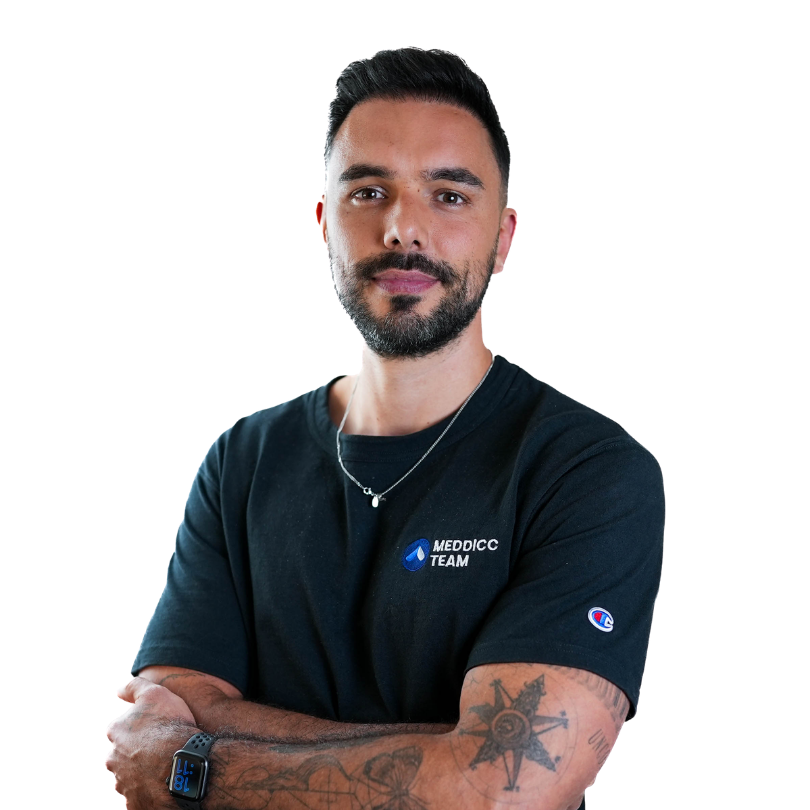
00:00:00 Misha Jessel-Kenyon: So it was $1.1 million ARR and $3.3 million TCV. We started the relationship — this was an existing account with a very small spend and we had to reset the relationship. So the economic buyer was previously the CMO, who had left, and previous champions had left. And we were then having a direct line with just one stakeholder at the time, which was the guy who was managing the platform technically. He was a great coach, but he had no power or influence. He thought he was a champion for it and could help expand it out. But a few times when we tested him, he was unable to get us in the right places or put us in the right meetings, and we very early realized that, hey, this guy — while he's got the right intentions — doesn't have the power to make things happen. He wants to help progress it, but we had to go back to basics. 00:01:06 Pim Roelofsen: Hey there. My name is Pim. I'm the Chief Revenue Officer here at MEDDICC, and this is another episode of Elite Dealers. With that, I'm welcoming to the stage Misha — welcome, brilliant to have you on. 00:01:17 Misha Jessel-Kenyon: Thanks, Pim. I appreciate you having me on. 00:01:19 Pim Roelofsen: Yeah, absolutely. So Misha — we're going to talk about one of your key deals that you did in one of the recent years. I think we want to start with setting the scene a little bit. Can you talk us through the type of customer, type of solution, length of sales cycle — those kinds of things? 00:01:34 Misha Jessel-Kenyon: Sure. This was around a nine-month sales cycle. It was a deal with a large public UK tech company. At the time, it was the largest deal in EMEA at Salesloft, and the second largest deal globally. 00:01:50 Pim Roelofsen: What are we talking numbers-wise? 00:01:52 Misha Jessel-Kenyon: So it was $1.1 million ARR and $3.3 million TCV — a three-year deal. And it was in the context of an organization where the average deal size was around 50K. ARR deals of this scale are rare, but I'd say this was probably both the toughest and also the most enjoyable deal of my career to date. It involved over 60 stakeholders on the customer side and 30 on our side. There were many times where I thought the deal wouldn't happen — and ultimately it became a life-changing deal for me. I was already significantly over target for the year and in the top accelerator bands, and it closed on the last day of the financial year. 00:02:38 Pim Roelofsen: That's crazy. Talk about a needle-mover deal — on multiple accounts. And I think I saw on your LinkedIn profile that you had a quarter where you hit something like 800 to 900%. Was this the quarter that deal fell into? 00:02:52 Misha Jessel-Kenyon: Yeah, that was the quarter. 00:02:54 Pim Roelofsen: I think one thing to get into here is that typically what I'd suspect is there's a strong foundation in terms of that organization being set up to do deals like this — or at least to get into evaluations like this. Typically we see a kind of playbook for a team in that position. What was that like for you at the time? 00:03:15 Misha Jessel-Kenyon: I'd say we were just starting to adopt playbook-type approaches. One of my best friends growing up was on his way up at a company called Multiverse, working with Jeremy Daga and Steve McCluskey, and he was learning and applying the MEDDICC playbook. I was learning it from him at the time. I ended up advocating to get the organization to roll MEDDICC out globally in partnership with my VP of Sales, Ollie Sharp. And we managed to hire a front-line leader who really knew MEDDICC — a guy called Willis, who came from Sprinklr — and he came in at a very critical time when this deal started to take shape and helped me apply the MEDDICC playbook. We also hired Sprinklr's lead business value consultant at the time. So those two resources coming in gave us the ability to take what was, in theory, a playbook approach and actually execute it in practice on this deal. 00:04:22 Pim Roelofsen: A lot of playbook pedigree coming together there. And a fun fact for our audience — Sprinklr is also the place where our founder here at MEDDICC, Andy Whyte, and Dave Dunkel, the creator of the MEDDICC framework, first met and worked together. Now they're both here at MEDDICC. And we also recently had someone join the team — Jake — who came from Multiverse as well. What you typically see with people who come from a strong playbook background is a very clear set of requirements for the first stage of the sales cycle and a very methodical way of working through the motions, with MEDDICC underpinning those motions. Was that the same for you in this particular deal? 00:05:08 Misha Jessel-Kenyon: Yeah, definitely. Very early on, the focus was trying to get early executive engagement and find pain — and then validating that pain with an executive who would sponsor an evaluation. We started the relationship — this was an existing account with a very small spend and we had to reset it. The economic buyer was previously the CMO, who had left, and previous champions had left too. We were left with a direct line to just one stakeholder at the time: the guy who was managing the platform technically. He was a great coach, but he had no power or influence. He thought he could champion it and help expand it out, but a few times when we tested him he was unable to get us into the right places or the right meetings. We realized very early that — although he had the right intentions — he didn't have the power to drive things forward. So we had to go back to basics and do proper pipeline development to get to the right stakeholder who could help the deal start to move. 00:06:28 Pim Roelofsen: Got it. Misha, I recently saw another podcast where you came on and talked about the concept of creating a POV — a point of view. Is that something you would do that early on in your process, and can you talk us through what that looks like? 00:06:42 Misha Jessel-Kenyon: Yeah, definitely. Right at the beginning — especially when you're trying to get early executive engagement — you need to come with some sort of point of view, some sort of opinion. Otherwise there's no reason for that executive to engage with you. They don't have time to sit and do discovery with you and tell you what's important. So early on, I took it upon myself to figure out what the most important initiatives and drivers in the organization were, so we could attach our solution to them. 00:07:07 Misha Jessel-Kenyon: We did this research on their annual report to find the key drivers. One was that they had a leaky bucket — renewal was a big problem for them. They were also trying to take out huge amounts of cost from the base, and part of our hypothesis was that they could move to a lower-cost inside sales model, which didn't really exist in a big way in the organization. We then supplemented that with information about how the existing deployment was already performing. I was able to engage the VP of Sales for the group of around 100 reps who were already using Salesloft at the time, and gather metrics on how that was performing — something that could help open up a conversation around the fact that we'd already proven our solution could help them generate more pipeline and work in that lower-cost inside sales model. 00:08:02 Misha Jessel-Kenyon: So it was a combination of figuring out where they were going and surfacing indications that we'd already proven we could support that direction. And it was really critical to getting that early meeting with the Chief Revenue Officer. The deal really started with building a POV, and then arming our CRO with a very specific, tailored message to set a meeting with their CRO. It was an exec-to-exec outreach. And that meeting is where we validated our assumptions — some things were off, some things were correct, and we refined it. We were able to get introductions to multiple VPs across different lines of business and start building the deal out — with an agreement that we would report back to the CRO on what we found. He sponsored our evaluation from the beginning because we came with a point of view that touched on the key initiatives he was responsible for. 00:09:17 Pim Roelofsen: I love that. So you're attaching yourselves to those strategic initiatives, and the POV empowers you to naturally transition the level of access you have within the business — earning the right to go deeper. If you think about pain, which is something you mentioned earlier — without pain, there's nothing to solve for. And you brought up pain in combination with the vast number of stakeholders, and the same pain can look different for different stakeholders. So as you were building out the business case and expanding your footprint in the business, how were you going about articulating pain to each new stakeholder that came into the deal? 00:10:08 Misha Jessel-Kenyon: Good question. The way we approached the engagement was to frame everything around a value pyramid of what the company was trying to do. Beneath that were value drivers associated with each VP we were engaging. They all had their own challenges, but all related to the overall transformational deal we ended up doing — which we branded as a go-to-market transformation. We ended up engaging with the VP of Customer Success, the VP of Inside Sales, and regional VPs of Sales. And that initial scene-setting — establishing the bigger picture before we dived into each stakeholder's specific element — helped us keep control of the deal. We were very transparent: "Hey, we're talking to all of these different people and we're building a unified proposition." They could trust that we would further their agenda as part of the bigger project, without each of them having to drive it individually. We were very conscious that if any single VP became our primary champion, we'd end up with a single divisional deal. What we were trying to do was tie all of these up into one complete deal that we could take to the board — one that addressed a bigger strategic initiative rather than just a VP-level one. 00:11:28 Pim Roelofsen: Can you talk to us about the role that decision criteria played in this? When you have the pain and you start to quantify the impact of the solution — positioning the metrics and getting consensus on them — how you uniquely deliver that gets articulated as decision criteria, which you reach consensus on together. How did that work in this specific deal? 00:11:57 Misha Jessel-Kenyon: Decision criteria was fairly critical. Early on, we were thinking about seeding requirements that were specific to us — things only we could deliver — even though the deal wasn't competitive at the time. And that became really important at a very late stage when a competitor entered the mix, which we'd somewhat predicted: if the deal became real, they might start looking elsewhere. If we hadn't protected ourselves by getting consensus on jointly agreed, written-down decision criteria, we could have been in a really tough spot — because we were suddenly competing against a free product. So it was: do you want to spend $3.3 million with us, or do you want to spend nothing on a solution that's in the same category and theoretically could do the same thing — if you don't look too carefully beneath the surface? 00:13:14 Pim Roelofsen: And that's exactly it — once you start articulating your value and arming yourself with decision criteria, you start protecting yourself against competitors coming in and saying "me too, we can do that, and we'll be cheaper." Was that exactly the dynamic you faced? 00:13:25 Misha Jessel-Kenyon: Exactly that. "Me too, we can do that — and you already work with us." So in terms of competition in this particular deal — was it just rival vendors, or was there inertia and other initiatives in the mix too? 00:13:41 Misha Jessel-Kenyon: It was all of those. We had "do nothing" — they had too much else on their plate, including a big IT implementation that was consuming everyone's attention. We had a competitor saying they could do the same thing. And we also had personnel changes mid-cycle. We got to a stage where we could have potentially done a renewals-only deal, but that didn't happen. Then a quarter later we could have done the inside sales deal, but that didn't happen because people changed roles. We had to win over new champions — someone took over sales, someone took over renewals and Customer Success globally, and we needed to bring each of them on board. And then the CRO wanted to make sure the budget came from the global IT transformation budget, which wouldn't happen if it was only a divisional initiative. If it stayed at divisional level, it would have had to come out of his budget. So it became a situation where we couldn't transact any of the smaller pieces without transacting the whole. 00:14:51 Pim Roelofsen: That's interesting — so you were also tying things to financial and commercial decision criteria. And going back a step — when you talked about seeding decision criteria from the beginning, this was something very proactive. You were positioning everything — the POV, the early champion meetings — with the mindset of: "This isn't something we need to uncover from the customer later, we need to build it together and reach consensus on it now, so that when we need it, it protects us against competition." Is that fair to say? 00:15:39 Misha Jessel-Kenyon: Yeah, that's fair to say. When you think about the playbook approach — very early on, we were identifying use cases, then documenting the requirements related to those use cases, and then calculating the impact each use case would have. What we ended up with was a business case that could stand on its own for each division, which then rolled up into one unified business case. And beneath that were the requirements — the decision criteria — that we'd seeded from the very beginning. Some evolved over time, but ultimately that's what protected us from losing the deal at the end, when a major competitor came in and offered the same thing for free. It wasn't actually the same thing — but it could have been perceived as the same thing if we hadn't gone through that process. 00:16:29 Pim Roelofsen: And Misha — the context of this deal is that it was vastly bigger than anything else the company, especially on the EMEA side, had seen before. What can you share about the process elements — the decision process and the paper process — which were probably quite different from typical deals? 00:16:50 Misha Jessel-Kenyon: I'd say what's unique about a deal like this is that you have to bring the whole company around a shared vision of the deal. You are just as much selling internally as externally. You're project managing internally — bringing in the subject matter experts for each piece, motivating them, and ensuring that each one owns a piece they can run with. And I'd say in the final two or three weeks when we were in procurement negotiation, there were some very tough moments — intense negotiations with the US, intense negotiations with my CFO, and my CEO. Having built a strong reputation in the organization prior to this deal happening unlocked a lot of things at that stage that might otherwise not have been possible. So I'd say: don't underestimate that element. You're not just selling to the customer — you're selling to your internal stakeholders too, and motivating them to want to work on your deal and feel good about it. 00:17:58 Pim Roelofsen: You're selling on both sides of the engagement. And something I want to pick up on is ownership. What we often see in our industry is that deal ownership is typically seen as sitting with the AE — they're the owner of the deal. But to your point, it really takes a large part of your organization and the customer's organization to make something like this happen. So when we think about ownership, it's really a team game — it's our deal to win and also ours to lose, not the sole responsibility of any one person. Did you feel that was the case in the environment you were operating in? 00:18:45 Misha Jessel-Kenyon: Yeah, definitely. The deal never would have been done without all of the people who rallied on our side — around 30 people, some more involved than others. Part of that was individual people on our side owning specific stakeholders on the customer side, and taking those relationships to the next level. So having our VP of Services matched to whoever was designing the rollout plan, having our CRO mapped to their CRO — and then making sure I was managing these almost like chess pieces, while also giving them autonomy and freedom to do the right thing. Strategically making sure the right people were having conversations with the right people, and then letting them own that element of champion building within the deal. 00:19:36 Pim Roelofsen: Multithreading on both sides of the engagement. And when you think about champion building specifically — is there anything you did from an in-person engagement perspective, like champion-building events? 00:19:54 Misha Jessel-Kenyon: So this was just coming out of Covid, which meant a lot of it happened remotely — which was frustrating. We pushed as hard as possible to get in-person engagement where we could. And one challenge we ran into mid-cycle was that we had multiple champions for different segments of the deal: a champion in VP Renewals and Customer Success, a champion in Inside Sales, champions across regional field sales leaders — but we didn't necessarily have one unifying deal champion who could pull it all together. The CRO could have played this role, but he was too busy day-to-day to be an effective deal champion. 00:20:35 Misha Jessel-Kenyon: We eventually identified that one of our sales operations champions had been promoted into a VP of Go-to-Market Transformation role — and that's where we started to shape the whole message around that initiative: "Go-to-market transformation with Salesloft." We honed in on the realization that this guy could be the perfect deal champion to get this done — this was his initiative, he could drive it. He lived in Barcelona. We were trying to figure out how to engage him properly, and it just so happened we had a company offsite in Barcelona. Me and my manager stepped away from the offsite — missed most of it — for a dinner that lasted about three hours. 00:21:40 Pim Roelofsen: Awesome — though I'm not sure in Spain they'd consider three hours a very long dinner. Maybe a short one! 00:21:45 Misha Jessel-Kenyon: We had like a nine-course meal, which was great fun. And we really built a strong relationship with this guy. We didn't just talk about business — not much of that conversation was about the deal at all. But having that in-person engagement allowed us to build a much stronger level of trust. And I'd say that added a whole layer of transparency to the engagement — so that later on, when things got tough, we could rely on each other to get things done. 00:22:24 Pim Roelofsen: And was this person your main champion going forward from that point? 00:22:27 Misha Jessel-Kenyon: Yes — he became our deal champion going forward after that event. We had all of these use case champions across the business, and they were all critical in getting it done. But this person was the most instrumental in packaging everything up into one transformational project. 00:22:45 Pim Roelofsen: If you think about the learnings — because this is a deal that will stay with you forever — and you would sum up the three biggest takeaways from this deal, what would they be? 00:23:06 Misha Jessel-Kenyon: I'd say, specifically from this deal, it really reinforced that pain and champion are the two most important ingredients in any deal, of any size. Something worth changing, and someone who cares about changing it and has power and influence to drive it. This deal was built upon a big enough pain — multiple significant pains at VP level that then added up to board-level pain — and a set of people motivated to make change based on their own personal motivations, with the power and influence to start driving that change. So without pain and champion, you've got nothing. I think that stands true in any sales situation. 00:24:18 Misha Jessel-Kenyon: The second thing I'd say is: when it comes to a transformation deal or a mega-deal, the most important thing to make it genuinely big is to make sure you're aligning to the most important board initiatives. Every board has a set of things that are the highest priority. If you're attached to solving those initiatives, that's what warrants prioritization, executive engagement, and big deals. Everything else is noise to the board — they won't want to engage with it because it's too much of a distraction. What worked so well here is that we took our tech solution and made it a key enabler for delivering on board-level initiatives. Without that, we would have ended up with multiple smaller divisional deals over a much longer period, drawn from individual budgets rather than one strategic one. 00:25:00 Misha Jessel-Kenyon: And the final thing I'd say is: be patient and trust the process. Ups and downs are inevitable in sales in any scenario, but especially in cycles like this. I still struggle with this myself sometimes, and I definitely struggled with it on this deal. There were many times where we thought we'd lost it. My Chief Revenue Officer at Salesloft, Steve Goldberg — a tremendous salesperson and a tremendous person — always used to say: "We'll lose a deal many times before we win it." And that is really true, especially in deals like this. 00:25:42 Pim Roelofsen: I love that. I believe there are even stats on that — you might lose a deal something like 40 times before you win it. And I think that applies in a very real sense to something like this. Before my final question, let me just wrap up some of my highlights. The way you went about decision criteria proactively — I agree entirely with pain and champion: you need something important enough to solve for, and someone who owns it with the right level of power and influence to be your partner in the evaluation. But decision criteria is where you make the difference in the long run, and protect yourself against anything else the customer might be considering. 00:26:20 Pim Roelofsen: I think we spent a lot of time on the playbook and on creating that POV — which is an absolutely elite thing to do to get access to the right stakeholders. The way you went about building multiple champions, multithreading on both sides of the engagement, while attaching yourselves to strategic initiatives — because that's where you uncover just how big the pain really is and the value you can unlock. And together, that value and pain drive the urgency. Absolutely loved it. 00:27:00 Pim Roelofsen: So, final question, Misha. The biggest piece of advice you would give to a ten-years-younger Misha — what would it be? 00:27:08 Misha Jessel-Kenyon: I would say: being in sales is a long game. Be patient. Trust that if you build the right skills, build a good reputation, and build strong relationships, it will pay off — at some stage, and probably at multiple stages. Don't be too worried about any given year as long as you're focusing on those things. Patience is probably the biggest thing I still struggle with now. But when you look back retroactively, you start to realize that things do go your way if you keep doing the right things. 00:27:55 Pim Roelofsen: I definitely resonate with that. I think that is spot on. Thank you for sharing that, and thank you for being on the show today. You're an absolute legend — thanks for making the time. Hopefully till next time. 00:28:07 Misha Jessel-Kenyon: Thank you, I appreciate it. Thanks for having me on.